


Editor’s Note: This story originally appeared in On Balance, the ARTnews newsletter about the art market and beyond. Sign up here to receive it every Wednesday.
The hype surrounding Seoul’s boom years is over. As Frieze Seoul returns for its fifth edition and KIAF marks its 25th anniversary this September, the city’s art market is entering a new phase. While collectors and dealers navigate more challenging terrain, signs point to a maturing market.
Seoul’s recalibration comes amid a modest improvement in global art sales. According to the most recent Art Basel and UBS Art Market Report, the global art market grew 4 percent in 2025 after two years of decline, while South Korea posted growth of 6 percent. Yet dealers on the ground report a more mixed picture.
“The mood has certainly changed,” Jason Haam, whose eponymous gallery has participated in Frieze Seoul since its inception, told ARTnews. “A few years ago, much of the optimism surrounding Seoul was driven by the strength of the market. Korea became an exciting place for major international galleries because collectors here were buying aggressively. That particular optimism has faded, but I think that is true of the global art market as a whole.”
Haam notes that while his gallery has raised its international profile, sales were stronger in 2021 and works have become increasingly difficult to move on the secondary market. “The easy flow of money has certainly stopped,” he said. “But the market is healthier and more mature. The collectors who remain tend to be genuinely passionate about art and are more likely to continue collecting over the long term.”
Seoul-based adviser Hong Chang-Hee said the speculative activity that accompanied the boom has subsided. Today, higher interest rates, economic uncertainty, and currency volatility have made “collectors more conscious of liquidity” and more selective when acquiring works priced above several hundred thousand dollars. That conscientiousness also extends to which artists are being acquired; Haam said he’s noticed more recently that Korean collectors are placing greater trust in “markets they can observe directly” and looking closely at contemporary Asian artists rather than defaulting to Western blue-chip names.
But collectors at the top end are still buying, according to Timmy Kim, a Seoul-based adviser and curator. He sees a bifurcation in the market: The old guard continues to acquire works by established names priced above $1 million from blue-chip galleries, while younger collectors typically buy works under $10,000, often of emerging artists from newer local galleries.
Mid-career artists, however, have found fewer buyers, said Kim. Some had previously benefited from speculative buying, but the secondary market for their work remains limited, he explained. In contrast, there is stronger demand for Dansaekhwa artists, who emerged in the 1970s. Government support also tends to favor younger artists, and leading galleries have limited space for mid-career artists.
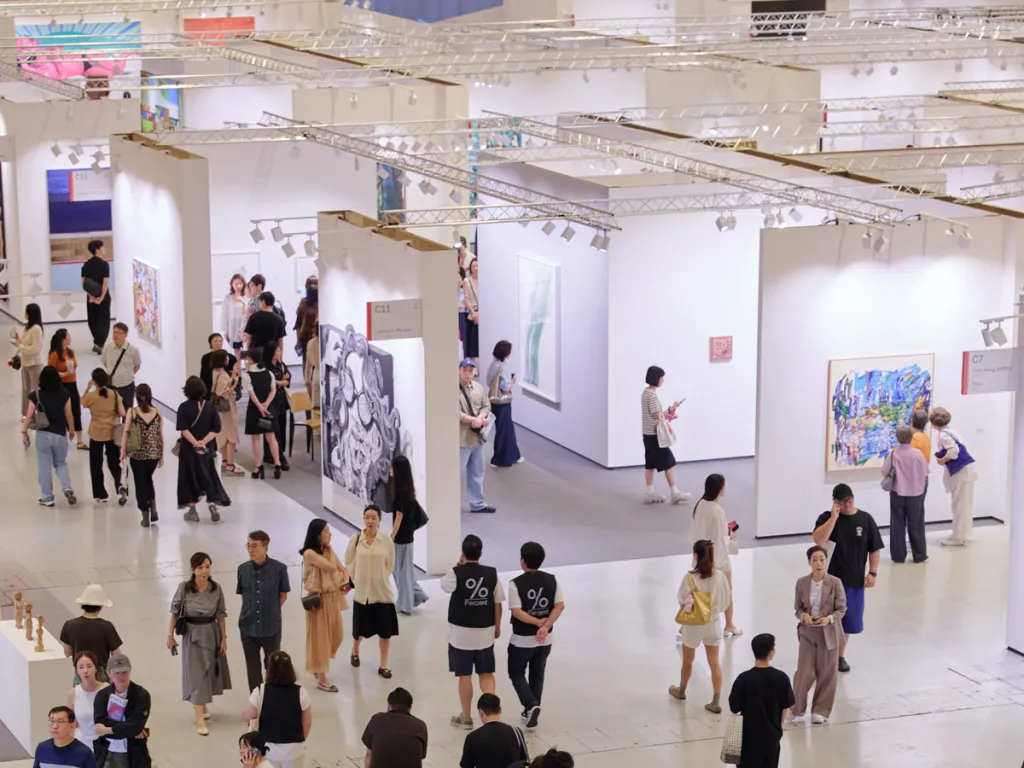
View of the 2025 edition of KIAF.
ⓒCreative Resource/Courtesy Galleries Association of Korea
According to Sunghoon Lee, chairman of the Galleries Association of Korea, which organizes KIAF, the Korean collector base has become more sophisticated: “While established artists and traditional media remain important, today’s collectors are generally more informed, curious, and confident in their own tastes. As a result, we’re seeing growing interest in emerging artists and a broader range of contemporary practices.”
Daegu-based collectors Jaeyong Cho and Hyunji Kim are one example. The couple began buying works by blue-chip artists such as Damien Hirst and Takashi Murakami, but their interests have since broadened. “Recently, we’ve found ourselves drawn to the diverse practices of younger artists working in the ultra-contemporary sphere,” said Cho, citing recent acquisitions of works by Korean artists Haneyl Choi and Heemin Chung. At the fairs, they also spend more time discovering unfamiliar artists and galleries rather than seeking out names they already know.
The fair landscape is also changing. Several dealers and advisers believe Frieze Seoul is becoming increasingly regional in character, a sharp contrast from its debut edition, when many local and international insiders thought it would beat out Art Basel Hong Kong for primacy in the region. Haam described the fair as “more local than Art Basel Hong Kong,” but said he sees it as a “natural evolution” as many fairs now serve their own regional ecosystems. Looking at this year’s exhibitor list that point bears truth: more than 70 percent of the 133 exhibitors are based in the Asia-Pacific region, while around 50 enterprises have permanent spaces in Seoul.
Timmy Kim, the adviser, noted that several collectors from the US flew in for the first edition of the fair but that number has since dwindled as the fair has “become more localized now.” He attributes that partly to when Frieze Seoul takes place: “It’s a month ahead of Art Basel Paris so it’s not attractive for [serious international collectors] to keep traveling.”
Some are more optimistic about international attendance. Mariko Kawashima, an Asia-based representative for São Paulo’s Mendes Wood DM, expects more overseas collectors to travel to Seoul this year because of the Gwangju and Busan biennales, in which the gallery has artists exhibiting. Mendes Wood itself is returning to Frieze Seoul after sitting out last year’s fair, when more than 40 galleries that had participated in the previous edition did not take part.
“Seoul has become an essential stop on the international art calendar,” says SoYoung Kim, director of Massimo de Carlo’s Seoul operations. “Galleries, museums, collectors, and artists increasingly see it as an important place to build long-term relationships.” Rather than returning to Frieze Seoul, however, the gallery will stage a pop-up with Korean artist Hejum Bä in a traditional hanok: “We’re very much part of that whole moment in the city, just outside the fair itself.”

Hejum Bä’s I Envy the Mother Conches (2026) will feature in her upcoming solo at Massimo De Carlo’s Seoul gallery.
Photo Yeonje Kim/Courtesy the artist and MASSIMODECARLO
Collectors have become accustomed to shuttling between events and openings spread across the capital. Next year they will also need to travel between Frieze Seoul and KIAF as the two fairs—dubbed “KIAFrieze” by locals—will no longer take place under the same roof. As COEX in Gangnam undergoes renovations, Frieze Seoul will move to the Zaha Hadid–designed Dongdaemun Design Plaza (DDP), a short distance from Frieze House Seoul, the year-round exhibition space the fair opened last year. KIAF will remain at COEX.
As Frieze Seoul has matured, the fair has also increased its local investment. South Korean retail conglomerate Shinsegae Group recently signed on as the fair’s headline partner through 2030. While some have raised concerns about the loss of synergies between the two fairs and DDP’s suitability for an art fair of this scale, Hong, the adviser, said Shinsegae Group’s broad reach could help the fair cultivate new collectors. “It has the potential to bring new energy to the Korean art market, which has been somewhat subdued in recent years.”
Outside the fairs, a string of gallery closures has shaken Seoul’s art scene, as it has in art hubs around the world. Several international galleries, including Peres Projects, König, and Various Small Fires, have shuttered their Seoul outposts, alongside local space One and J. Gallery. Haam likened the closures to the period following the 2008 financial crisis. “We enjoyed a remarkably long period of growth, and today’s slowdown should be understood as a long-overdue market correction,” he said, adding that galleries need to rethink how they operate in Seoul.
Other foreign dealers remain committed. Meyer Riegger opened a Seoul space in collaboration with Galerie Jocelyn Wolff last year, while Gladstone Gallery is doubling in size and relocating to Hannam-dong ahead of the fairs.
Beyond the commercial sphere, Seoul’s institutional scene is developing. Centre Pompidou partnered with the Hanwha Foundation of Culture to open a museum on Yeouido Island in June, while PhotoSeMA, the city’s first museum dedicated to photography, opened last year and the Songhyeon Cultural Center, an exhibition space meant to house the 23,000 works donated by Samsung founder Lee Kun-hee, is slated to open in 2027. Korean institutions, including the National Museum of Modern and Contemporary Art, Korea (MMCA), are also increasingly partnering with counterparts overseas.
MMCA director Kim Sung-hee has observed that local collectors are becoming more open to supporting museums and cultural institutions, which she describes as part of the “maturation of Korea’s culture of giving.”
View of the northern facade of 739-28 Hannam Building, which will serve as the main entrance to the Gladstone Gallery’s new Seoul location.
Courtesy Mass Studies
Frieze Seoul director Patrick Lee has observed the same shift. “What is particularly encouraging is the level of engagement beyond collecting itself. Many collectors are contributing through patronage, education, and support for artists and institutions.”
Not everyone agrees, however. Timmy Kim is more cautious, saying Korea has yet to develop a strong culture of museum patronage. He pointed to gala dinners as one Western fundraising model that does not easily translate to Korea. “Korean culture is very different,” he said. “We have many hidden collectors in the Korean market who don’t want to expose themselves.”
But he believes that could change with the next generation, who are more inclined to attend events publicly—and with a deepening sense of engagement. “When I go to museums, I feel like the young audiences are discussing the art, not just taking pictures,” he said. “The environment is way more developed now.”
Emma Son, Seoul-based partner at Lehmann Maupin, sees similar promise among Korea’s growing cohort of young collectors. “While they may begin with more modest acquisitions, many are thinking long term and developing thoughtful collections from an early stage. That kind of sustained engagement is very encouraging for the future.”
