


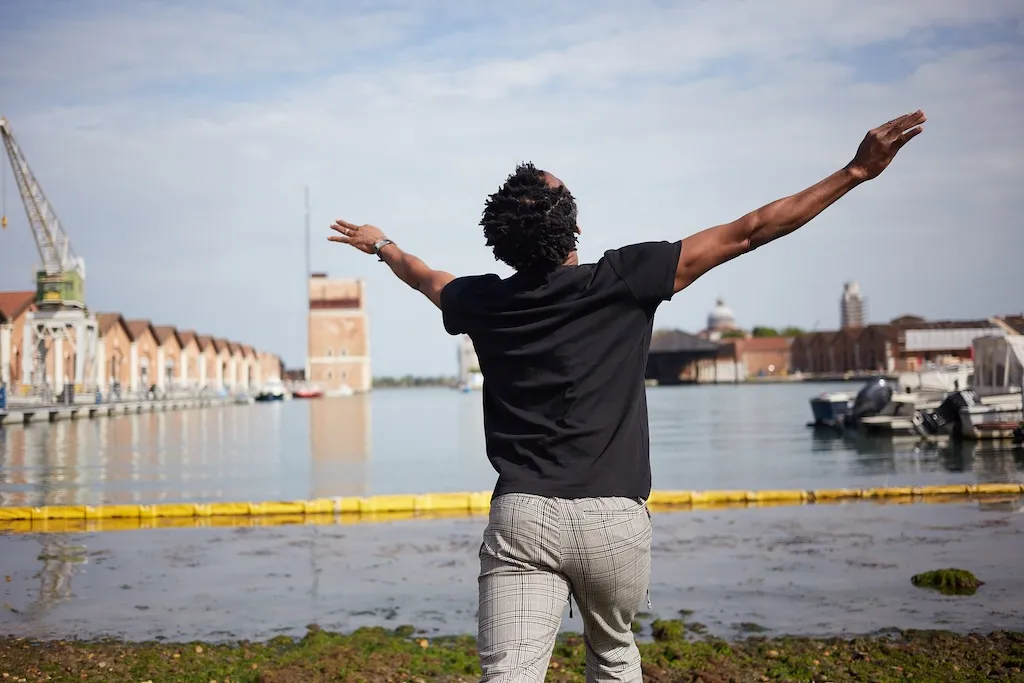
Last month, Faustin Linyekula stood at the edge of the lagoon beside the Arsenale, looking out over the water. He bent down and ran his hand along the moss that clings to the concrete docks, then began to sing. His voice carried across the basin, past the bell towers and into the empty military warehouses, the sound echoing through spaces that, in a matter of weeks, would be filled with art and people.
For now, though, Venice was quiet. Three weeks before the Venice Biennale opens to press and invited guests on May 5, much of the city’s exhibition infrastructure remained off-limits or unfinished. The Giardini, the public gardens that houses many of the national pavilions, was closed. Access to parts of the Arsenale, which serves as a site of the curated section of the Biennale as well as some pavilions, required special permission and an escort. What will soon be one of the most crowded stages in the art world feels, in late April, more like a construction site than a cultural capital.
What does it take to build an art event here? At times, it begins to feel less like installing an exhibition than digging trenches. Venice is a city built on timber piles driven into mud more than a thousand years ago, its infrastructure both stubborn and fragile. Every two years, it is asked to support a global exhibition layered on top of that foundation, one that must be shipped in, assembled, powered, insured, and opened on a fixed deadline.
This year, those pressures are harder to ignore. Geopolitical conflicts—most notably wars in Iran and Ukraine—are rampant, pushing up shipping costs, disrupting supply chains, and complicating the movement of materials into Europe. At the same time, the Biennale has become a flashpoint for political disputes over national exhibitions, particularly those of Israel and Russia, and controversies continue to overshadow the art that will appear at multiple pavilions. As I write this, the whole of the Biennale’s international jury cryptically resigned via Instagram, leaving people on the ground in Venice wondering what the next calamity will be.
And yet the work goes on. While I was in Venice, three weeks before the opening, across the Giardini, in churches, former naval buildings, and improvised studios, artists, curators, and technicians were quietly assembling an exhibition that, when it opens, will appear seamless. The strain, for the most part, will remain invisible.
Venice As She Is
Linyekula’s performance, The Galeazze Project, takes place in a vast, roofless complex at the far edge of the Arsenale Nord, built in the 16th century to store machinery and materials for the Venetian fleet. For decades, the space has been largely inaccessible, used intermittently for storage, its future still undecided.
When Linyekula first visited in January, there was almost nothing there. No staging, no seating, just an ancient shell and pockets of overgrown grass. Rather than impose a structure onto it, he began asking what the space already offered.
Faustin Linyekula stands on top of a large mound of gravel in the Galeazze in Venice’s Arsenale. Photo by Daniel Cassady.
“For me, it’s first a question of listening,” he said. “How does this space speak to my body? And what kind of response does that trigger?” The answer, in this case, was not to transform the Galeazze, but to meet it on its own terms.
The performance, presented by the foundation Scuola Piccola Zattere and Studios Kabako, uses what is already there or close at hand: gravel sourced from the Veneto region, stacked in mounds and packed into industrial bags that double as seating; light that shifts naturally as evening falls; sound that travels across water and stone.
The lagoon acts as an amplifier. Brass instruments will cut across the basin with notes ricocheting off the surrounding structures. Audiences will not sit facing a stage. They will move through the site, gathering first along a narrow path by the water before being drawn deeper into the complex, guided by performers who emerge from different points in the structure.
Curator Eduardo Lazzari described the project as an attempt to “embody the archive of the space,” treating the Galeazze not as a backdrop but as an active presence, layered with histories that the performance can activate rather than overwrite. In that sense, The Galeazze Project offers one answer to the problem Venice poses. Rather than forcing the city to accommodate the work, it allows the work to be shaped by the city’s limits.
By Land or By Sea
Barry X Ball’s exhibition, “The Shape of Time,” will fill the Basilica of San Giorgio Maggiore with 23 sculptures, many of them shown publicly for the first time, arranged across the nave, sacristy, and choir stalls of the Palladian church. Some are monumental, including 10-foot-tall figures based on Bartholomew Flayed from the Duomo in Milan. Others are smaller, highly worked objects that have taken years to produce. One, a portrait of Pope John Paul II in silver and gold, has been in progress for more than a decade.
Getting them to Venice has been its own project altogether.
The sculptures left Ball’s studio in Brooklyn’s Greenpoint neighborhood in early February, packed into dozens of custom-built crates and loaded onto a container ship bound for Italy. The plan was straightforward: cross the Atlantic, dock near Trieste, and move the works by truck and boat into Venice with enough time to install before Easter. Instead, the ship stalled along the East Coast, making multiple stops in Norfolk, Virginia, before crossing the Atlantic and veering off course.

In the choir room of the Basilica San Giorgio, crew members install one of the nine heads that make up Barry X Ball’s Pseudogroup of Giuseppe Panza (1998–2001). Photo by Daniel Cassady.
Ball tracked its movement digitally in real time. As it approached Italy, it turned south, stopping first in Alexandria, Egypt, where his containers were offloaded and left on the ground, then continuing on to Haifa, Israel, before eventually making its way back toward the Adriatic. No one at the shipping company would explain the detour.
By the time the works began moving again, the schedule had collapsed. The crates, which were meant to arrive weeks before installation, were still in transit with days to go before work needed to begin. Ball and his team built a cushion into the timeline, but even that proved insufficient. In the end, the shipment was roughly three weeks late, forcing a compressed installation schedule that would require round-the-clock work to meet the opening.
Even under ideal conditions, staging a show in Venice demands a level of coordination that most exhibitions never approach. Works arrive not at a loading dock but through a chain of transfers, from cargo ship to port, from port to truck, from truck to smaller boats, and finally by hand into buildings that were never designed to receive them.
The costs accumulate at every step. Ball, a veteran at the Biennale who is financing the exhibition himself with the help of a small group of patrons, wouldn’t share the exact number he thinks he’ll have spent but said he knows many exhibitions will wind up costing “a couple million.” That figure does not include the years of fabrication behind the works themselves, some of which carry seven-figure production costs.
Rent alone can run between $30,000 and $50,000 per month for a major venue during the Biennale, a six-month commitment that begins long before the first visitor arrives. Security is another major expense. Ball is paying for guards in two shifts each day, a cost he puts in the hundreds of thousands over the run of the exhibition. Shipping, custom crates, local transport, installation crews, lighting, insurance, and public relations all add to the total.
Much of that burden is usually absorbed by galleries or institutional backers. In this case, Ball has taken it on himself, effectively acting as his own producer, logistics manager, and financier.
The result is a show that, when it opens, will appear composed and deliberate, its works placed in careful dialogue with the architecture of the basilica. The months of planning, the detours across the Mediterranean, and the final rush to install will by then have disappeared into the background.
“You Have to Be Flexible”
Some artists take a different approach. At the Icelandic Pavilion, Ásta Fanney Sigurðardóttir built her show, “Pocket Universe,” around the idea that things might not go according to plan, so you might as well plan for that. The exhibition will feature film music, performance, and a handful of objects spread through a former shipyard space near the Arsenale. The team shipped what they could from Iceland, including speakers from an old ’90s movie theater in Alvabakki, and massive rolls of an Icelandic wool called lopi that will serve multiple purposes in the pavilion, from sound absorption to decoration. Then she and her team, including curators Margrét Áskelsdóttir and Unnar Örn, filled in the gaps once they got to Venice, buying carpets and other materials from around Italy to avoid delays.
Crew members with the Iceland Pavilion unload large carpets from a boat docked in the island of San Pietro. Courtesy, Ásta Fanney Sigurðardóttir.
Sigurðardóttir doesn’t fight any possible changes or mishaps—she expects them. “If it doesn’t arrive, I will fix it differently. You have to be flexible to move easily through life,” she said. When a shipment goes missing or a material shows up wrong, the response isn’t to stop and wait. It’s to adjust the work. At one point, even a missing piece turned into part of the logic of the show, another detour folded into the process.
The Pressure Doesn’t Stop Once the Doors Open
At the Armenian Pavilion, the work won’t show up finished.
Zadik Zadikian’s project, The Studio, turns a 5,000-square-foot space inside the Arsenale into a working studio, where Zadikian and his assistants will spend the six months of the Biennale’s run making and remaking sculptures in front of visitors. The idea goes back decades, to when Zadikian was working in Iran with art dealer Tony Shafrazi and became fixated on the way laborers stacked clay bricks, repeating the same gesture over and over until something larger took shape. That’s still the core of the work: Zadikian builds stacks of brick-like sculptures, pulls them apart, and builds them again, over and over. In Venice, that simple idea turns into a logistical problem.
A studio needs materials, and those materials have to keep arriving. The pigments that give the sculptures their color are coming from Los Angeles in batches, with enough on hand to last a few months before the next shipment. Other supplies are being pieced together as they go. Some things come from Italian suppliers. Some are ordered when they’re needed. It’s a rolling system, not a fixed one.
Even the sculptures are adjusted for the setting. What looks like solid plaster is actually built over foam, which keeps the weight down and makes it possible to keep moving and rebuilding the work inside the space without heavy machinery.
Once the Biennale opens, the studio runs on a schedule. They start in the morning, work through the day, and visitors walk in and watch it happen. You see the building, the breaking down, the starting again.
That also means the pressure doesn’t stop once the doors open.
Most shows absorb their problems before anyone arrives. This one has to keep going for six months. Materials have to show up. People have to keep working. If something slows down, it will be visible. Tina Chakarian, who has overseen Armenia’s presence at the Biennale for years, said her team has tried to get ahead of that by locking in the essentials early and setting up a system that can be replenished as needed. But a few things can’t be easily replaced. The pigments, in particular, are specific to Zadikian’s process. If those don’t arrive, the work might have to change.
Zadik Zadikian in his LA studio, 2026. Photo by Ruben Diaz
Courtesy Tony Shafrazi / Gallery Without Walls
In this case, the exhibition ends up showing more than the finished sculptures. It shows the effort it takes to keep making them. Occasionally, however, the effort starts well before the artist’s materials ever arrive.
Curator Christian Viveros-Fauné is staging “Iván Tovar: Le Retour,” a survey of paintings and sculptures by the late Dominican painter, inside the Ex Istituto Idrografico at the Museo Storico Navale, a former hydrographic institute on the waterfront in Castello, part of the old naval complex near the Arsenale. The space sits less than 100 feet from the canal and, like much of Venice, wasn’t built with contemporary exhibitions in mind. It had no proper air conditioning, no humidity control, and limited electrical capacity—basic requirements when you’re showing paintings valued in the hundreds of thousands of dollars.
So before a single work could be installed, the team had to retrofit the building. That meant new electrical just to power climate control, and a rush to install air conditioning in a structure that’s part of a historic naval site still under the jurisdiction of the Italian Navy. The lease only kicked in at the start of April, leaving a matter of weeks to make the space functional. “We’ve had to essentially fit out the entire space,” Viveros-Fauné said. According to one source with experience building out spaces in the Arsenale, the electrical and air conditioning alone could cost up to $1 million.
Locals and Insiders
Behind many of these projects are people who rarely appear in the credits.
Pia Capelli is one of them. Based in Venice, she has worked with galleries, museums, foundations, foreign culture ministries, both before and during several editions of the Biennale as a strategic adviser and in some cases project manager, pairing artists, galleries, and institutions with the right spaces and helping shape projects long before installation begins. “In a way, I’m a matchmaker,” she said.
That work often starts earlier than people realize. A year is the bare minimum for a major project. Many begin closer to two. By the time the current Biennale opens, the next one is already underway, with organizers walking clients through active exhibitions to secure venues for the future.
What catches people off guard is rarely the art. It’s everything around it.
“Logistics,” Capelli said, is the part most often underestimated. Getting a work into a building can depend on the width of a canal, the height of a bridge, or whether a boat carrying a crane can physically reach the site. Some vessels can’t pass under Venice’s bridges. Others can’t navigate the smaller canals at all. If the route doesn’t work, the artwork doesn’t arrive.
VENICE, ITALY – DECEMBER 31: A gondola makes its way along the Grand Canal next to Palazzo Franchetti on December 31, 2021 in Venice, Italy. Venice is among Europe’s top tourist destinations. (Photo by Sean Gallup/Getty Images)
Getty Images
Costs follow the same pattern. Budgets can be mapped out early, but they tend to balloon as installation approaches, when problems become concrete and expensive to solve. Even disposal carries a price. Removing materials from a site often requires boats and labor, to the point where it can be cheaper to store or donate structures than to throw them away.
Money helps, but it isn’t decisive. Venice doesn’t function as a simple rental market. Churches, palaces, and institutional spaces all operate differently, and access often depends as much on relationships and experience as it does on budget. “You can be very wealthy and still not find a venue—or the perfect project,” Capelli said.
For a city of fewer than 50,000 residents, the pressure is constant. Capelli pointed to the rising cost of living and the spread of short-term rentals, which have pushed many locals out of the historic center. The Biennale brings work and attention, but it also adds to the strain, layering a global event onto a place that is already stretched. So relationships matter.
By the time the Biennale opens, most of that work has disappeared. Capelli is quick to point out that the work isn’t only transactional. Venice is difficult, she said, but that difficulty is part of the draw. “It’s a privilege working here. Your brain is entirely engaged, and you’re compensated for any logistic nightmare by the beauty of the place where you’re working.”
