


What We Miss When We Talk About Giacometti
“Everyone knows what a head is!”
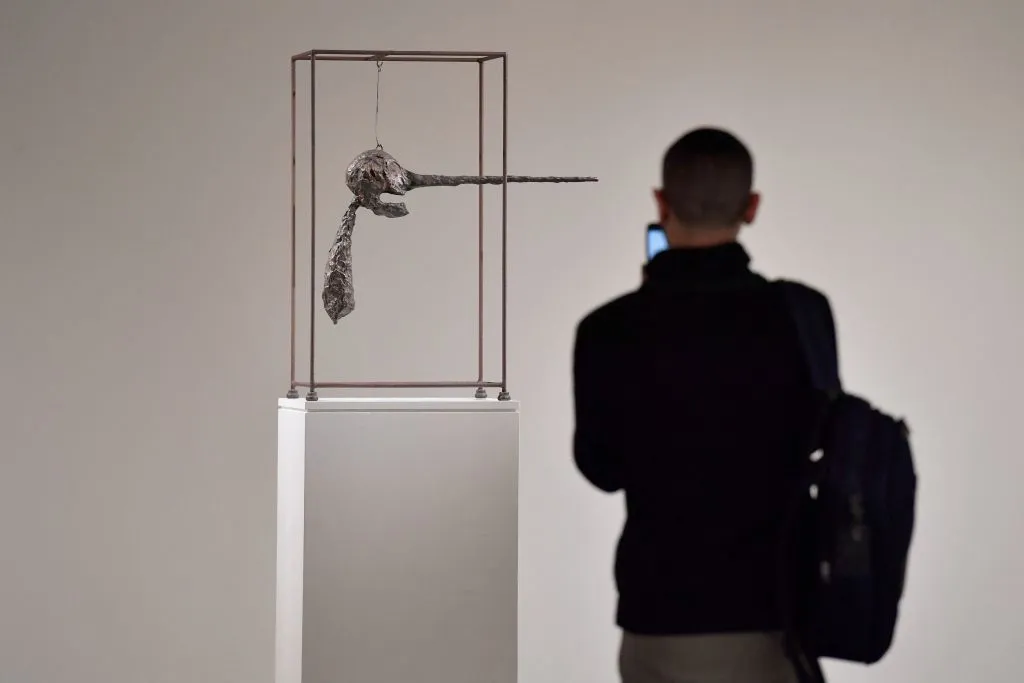
Thus André Breton—the imperious leader of the French Surrealist group with which Alberto Giacometti had made common cause in the late 1920s—chided the artist for his return to sculpting human likenesses after 1935. The Swiss-born, Paris-based Giacometti had distinguished his tenure as a Surrealist with a range of enigmatic objects: inscrutable gameboards wrought from sleek marble slabs; stylized, fragmented bodies indebted to non-Western “primitive” cultures; barbed wooden implements stripped of evident purpose whose titles gleefully announced their “disagreeability.” The Surrealists found these sculptures to be a striking distillation of the movement’s obsessions: with menacing fetishes, repressed desires, and willful dysfunction. “Not I,” Giacometti replied tersely to Breton’s high-handed declaration about knowing what a head is. The riposte sealed his break with Surrealist affiliation.
It would nevertheless take another decade or so to hone the works with which he remains most widely and abidingly associated. Whether still or striding, tiny or outsized, Giacometti’s elongated, upright figures persist as some of the most recognizable works of the post-World War Two era. Their solitude, solemnity, and seemingly wounded surfaces invited endless projections about the predicament of humanity following the Holocaust and Hiroshima. From the late 1940s until his death in 1966, these figures came to embody hard truths about a world irrevocably changed by war and genocide. They have also been taken ever since as the almost preordained culmination of the artist’s oeuvre—the yardstick by which we measure his work and its response to modern life.
Alberto Giacometti working on a model in his room in the Hôtel de Rive in Geneva,
before October 1944
Photo Eli Lotar. © 2024 Succession Alberto Giacometti/Artists Rights Society (ARS), New York/ADAGP Paris.
But what separates the two major phases of his career, the Surrealist and the Existentialist? What about the ten years during which Giacometti sculpted human heads from live study, and carved innumerable miniscule figurines? How did the virulent nationalism and fraught politics of France’s interwar period—no less racked by crisis than its nuclear-era dénouement—inform the artist’s approach to figure and form? Joanna Fiduccia’s new book Figures of Crisis: Alberto Giacometti and the Myths of Nationalism frames the period between 1935 and 1945 not as an interlude but a fulcrum, not an abeyance but a lightning rod.
The plaster head studies that preoccupied Giacometti by the late 1930s, like the countless miniature figures that he mounted atop large square bases during the same years, were almost entirely excluded from the Museum of Modern Art’s centennial retrospective of 2001. Just two of the works appeared as supposed stopovers on the way to a “mature style.” In four richly illustrated and tightly argued chapters, Fiduccia defies the neat categorizations that have occluded a crucial cycle of work, examining Giacometti’s move away from Surrealism into wide ranging and less clearly defined experiments.

Along the way, the Yale art historian inflects canonical works with fresh insight, shedding light on the two seasons into which the artist’s sculpture is relentlessly confined in art historical accounts. The result is a book which not only excavates an underexamined period in twentieth-century aesthetics, but dynamizes our understanding of modernist figuration and its relationship to politics, challenging received polarities and historiographic distinctions. In Fiduccia’s perceptive reading, binaries such as abstraction and likeness, form and formlessness, seriality and singularity, take on dialectical tension and interrelation. The disturbance of epistemological certainties evocatively matches—and illuminates—Giacometti’s varied practice.
The artist himself characterized his return to sculpting from live models as the only way to seize the “totality of life.” Paradoxically, his quest for totality entailed a diminishment—of size, of scale, of material. To be sure, Giacometti’s Surrealist compositions had employed absence, subtraction, and ellipsis to stunning effect. Yet part of his new works’ peculiarity lay in how they rendered human resemblance itself a site of anxious ambivalence. Fiduccia convincingly distinguishes this reprisal of figuration in the mid-1930s from the more conservative “return to order” which had marked European (especially French) culture in the wake of the Great War’s horrors. Rather than rehearse soothing representations of bodies or objects, the artist channeled crises both personal and political into an interrogation of representation in and on its own terms. Portrait busts and diminutive figures—some barely bigger than a pin—served as vectors of constructive uncertainty. The process of seizing life for Giacometti during this period entailed a sculpting hand that—in Fiduccia’s lively phrasing—“builds one moment and deals the death blow the next.”
The dual potential of crisis to inhibit or to stimulate creativity forms a key subject of the book in its own right. As Fiduccia notes, most accounts of Giacometti’s oeuvre treat crisis as “the gear that keeps the work turning.” Rather than take his busts and miniature figures as generic illustrations of collective angst, she historicizes the relationship of their shifting materials, formats, and scale to historical and subjective contingencies. All the while, she keeps close hold of Giacometti’s working methods and their sensitivity—whether intentional or unwitting—to contemporary philosophical discourses. Close studies of individual sculptures and paintings (a medium that intermittently occupied him throughout his entire career) gain further substance through considerations of works by other artists like Auguste Rodin and Antoine Bourdelle (Giacometti’s former teacher), Constantin Brancusi and Salvador Dalí, Francis Gruber and Max Weber.
Alberto Giacometti: Figurine on a Double Base, c. 1939.
Photo © 2024 Succession Alberto Giacometti/Artists Rights Society (ARS), New York/ADAGP Paris
Even less familiar than Giacometti’s plaster heads or mounted miniatures are his designs for the Swiss National Exhibition of 1939, which forms the subject of the book’s third chapter. Planned amidst the rising fascist tides that by this date buffeted Switzerland’s borders on the south and north alike, the exhibition aimed to shore up a sense of national identity in a country famously marked by diverse linguistic and cultural traditions. The diminutive scale of Giacometti’s proposal—a nondescript bust atop a small square base—puzzled his colleagues. The project never came to fruition. Yet at a vital moment of national self-representation, the design’s self-effacing dimensions stirred up far-reaching questions about scale, politics, and monumentality.
Some of these questions anticipated a striking and unrecognized facet of the artist’s legacy, which Fiduccia addresses elsewhere in the book: namely, Giacometti’s reconfiguration of sculpture’s relationship to the wider environment. He deployed solitary bodies not merely to represent themselves, but to activate the empty space around them. Minimalist artists like Donald Judd and Richard Serra appreciated Giacometti as a sculptor of phenomenological situations rather than simply a fashioner of bodies. This underacknowledged affinity helps us move past hackneyed accounts of Giacometti as the unprogressive author of monuments manqués (“models of a conception of publicity long past,” in Benjamin Buchloh’s patronizing appraisal).
There are moments when the book, in defending Giacometti, seems to overburden his oeuvre with an exponential set of aesthetic, intellectual, and political problems, from resolving the tensions between modernism and the avant-garde to a singular working through of national trauma. Given Giacometti’s twin allegiances to Switzerland and France, the specific nationhood in crisis likewise feels at times overdetermined. Yet the consequence of Figures of Crisis ultimately transcends geographic or biographical particulars. Its attention to the problem of creativity in the teeth of noxious nationalism speaks eloquently to our moment nearly a century later—on the eve of a new ‘30s seemingly bound up with a familiar xenophobia, mounting racism, and resurgence of reactionary politics.
Alberto Giacometti: Very Small Figurine, c. 1937–39.
Photo © 2024 Succession Alberto Giacometti/Artists Rights Society (ARS), New York/ADAGP Paris
The growing resurgence of interest in Giacometti’s legacy makes Fiduccia’s volume all the more timely. London’s Barbican Center has dedicated a series of innovative exhibitions pairing his sculptures and paintings with work by contemporary artists such as Huma Bhabha, Lynda Benglis, and Mona Hatoum, lasting through this spring. Boston’s Museum of Fine Arts has installed an “Imaginary Dialogue” between Giacometti and Mark Rothko, based upon their respective unrealized 1969 commissions for the UNESCO headquarters in Paris. The first ever museum dedicated to the artist, meanwhile, will open in Paris in 2028. Located near the Seine in the city’s 7th arrondissement, the Musée & École Giacometti will house the largest collection of his work in one site, comprising more than 10,000 items and a wealth of archival material.
Fiduccia wisely notes that modernist art owes a debt to crises of all sorts. Its formal and ontological affinities with dysfunction, fragmentation, and violence would seem to render that debt proverbial to the point of cliché. Figures of Crisis makes productive use of this commonplace idea by tackling it head-on and turning it inside out. The book’s achievement rests not merely in lending rich texture to the frequently flattened complexities of Giacometti’s oeuvre, but in considering how the turbulence of crisis can in fact bring certain phenomena—aesthetic, ideological, and individual—into clearer relief. Fiduccia’s attention to vital questions about modernist sculpture and Giacometti’s role in its development—the problem of surface as an indicator of depth; the tensions between objecthood and image; the painful and joyful gaps between seeing and figuring—echo beyond these gripping pages into a wider discourse about what might make or keep us human.
