


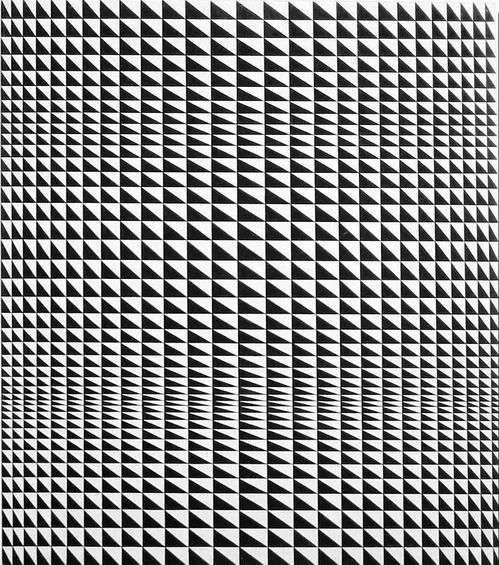
Straight Curve, 1963
Bridget Riley
El Museo del Barrio
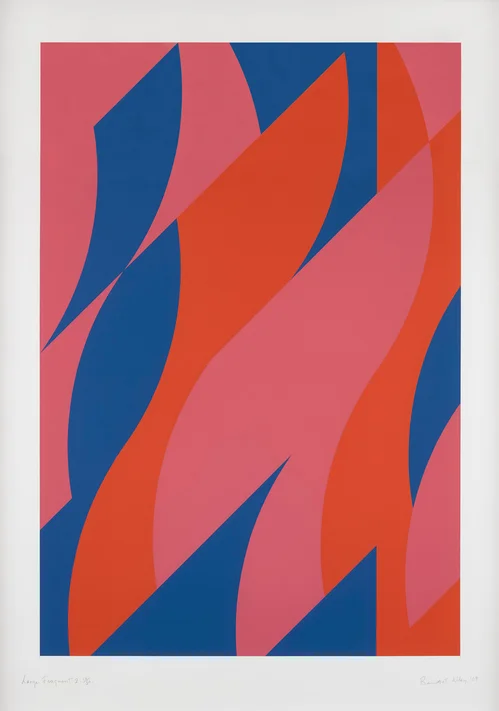
Large Fragment 2, 2009
Bridget Riley
Cristea Roberts Gallery
Widely regarded as a leading figure in post-war abstraction, Bridget Riley transformed geometric painting. Her works generate a remarkable sense of movement from simple forms. Through meticulously structured compositions, her work explores how line, shape, and color can pulse and shift before the eye.
This summer, Dia Beacon will present an exhibition focused on some of Riley’s earliest black-and-white paintings. Spanning works made between 1961 and 1967, the exhibition revisits the period that established Riley as one of Op art’s defining figures.
Characterized by optical effects, Op art emerged during the 1960s as artists increasingly explored perception through abstraction. Riley’s work gained widespread attention through major survey exhibitions of the genre, such as “The Responsive Eye” at the Museum of Modern Art in 1965, which was famously featured on the cover of Time magazine the following year.
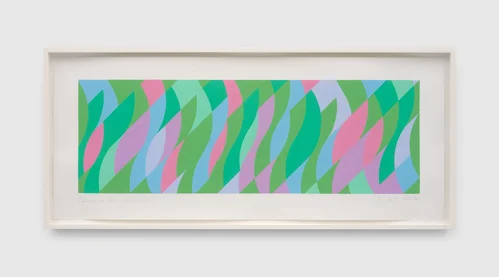
September 10, Revision of August 28, 2004, 2004
Bridget Riley
David Zwirner
“Bridget Riley uses deceptively simple, painstakingly intricate geometric motifs to create compositions that seem to compress and expand as the viewer’s eye moves around the canvas,” said Dia curatorial associate Emily Markert. According to her, these early paintings “demonstrate how self-imposed limitations on color palette and formal vocabulary proved generative for the artist, and laid the groundwork for the next six decades of her career.”
Riley has often emphasized the experience of viewing itself. Reflecting on her practice in a 2020 interview with the Morgan Library, she remarked: “I know that my paintings declare absolutely everything. Nothing is hidden whatsoever. At the same time, by looking at it, you find things to look at and you see colors, and so things open out.”
More than half a century later, contemporary artists are still fascinated by the questions Riley helped bring to the forefront of abstraction—about color, perception, structure, and repetition. Here are eight artists who are influenced by Riley’s approach, demonstrating how the optical abstraction she helped pioneer continues to evolve across generations and geographies.
Cristina Ghetti
B. 1969, Buenos Aires. Lives and works in Valencia, Spain.
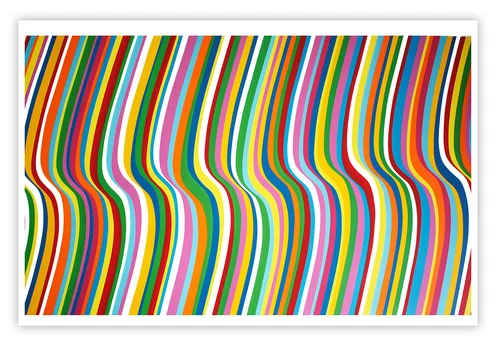
Mareas (Abstract print), 2024
Cristina Ghetti
IdeelArt
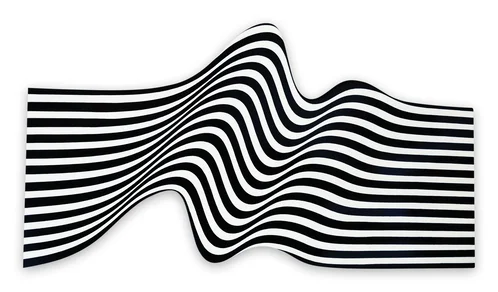
Double Wave Black (Abstract painting), 2017
Cristina Ghetti
IdeelArt
Argentine painter Cristina Ghetti describes Bridget Riley, Lygia Clark, and Sonia Delaunay as her “artistic sisters.” Drawing on the rich tradition of Latin American geometric abstraction, Ghetti creates paintings and prints that use pattern, color, and repetition to complicate seemingly stable geometric structures.
The acrylic-on-wood painting Double Wave Black (2017), composed of black-and-white bands that undulate across the shaped surface, demonstrates Ghetti’s longstanding interest in the relationship between order and variation. Reflecting on Riley's influence, Ghetti told Artsy, “Black-and-white continues to offer me an inexhaustible field of possibilities,” revealing how subtle changes within a limited palette can generate remarkable movement.
Ghetti continues to expand her investigations into abstraction through international residencies, most recently in Shanghai and, later this year, in Costa Rica.
Andy Harwood
B. 1983, Brisbane. Lives and works in Ipswich, Queensland, Australia.
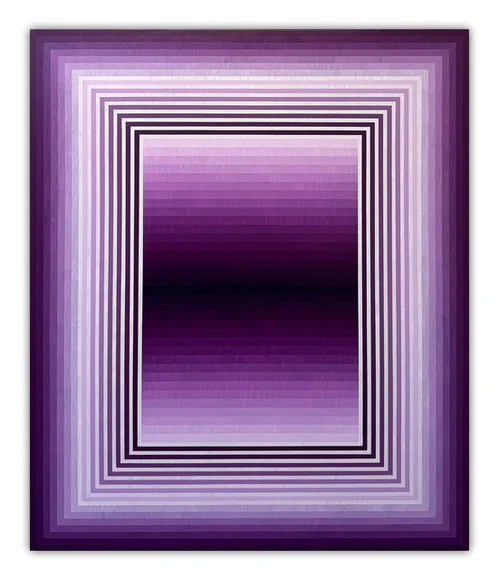
Extended Light (Cobalt Violet) (Abstract Painting), 2024
Andy Harwood
IdeelArt
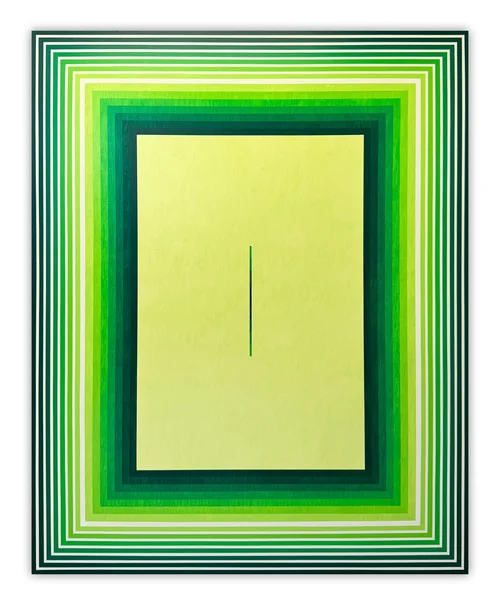
Autosuggestion (Green) (Abstract Painting), 2025
Andy Harwood
IdeelArt
Andy Harwood describes his paintings as “a study of the mechanics of vision.” Influenced by Josef Albers’s theories of color interaction, the Australian artist uses geometry, light, and color to explore perception.
In Light Consideration 16 (2025), nested rectangles of translucent ultramarine blues—ranging from sky blue and cerulean to near navy—fold inward upon one another in successive layers. Repeated geometric forms and semitranslucent gradients create the illusion of receding and advancing planes, while soft transitions of color dissolve the hard edges. The result is a composition that oscillates between movement and stillness.
Harwood credits Riley with bringing a sense of movement and feeling to geometric abstraction. “A lot of Op art painting, I feel, is trying to be too clever or tricky,” he told Artsy. “Riley’s work used movement to make the works feel organic.” Currently based in Ipswich, Harwood is developing a new body of sculptural work, some of which will be included in an upcoming solo exhibition with Jan Manton Gallery in Brisbane.
Myles Bennett
B. 1983, Nashville. Lives and works in New York.
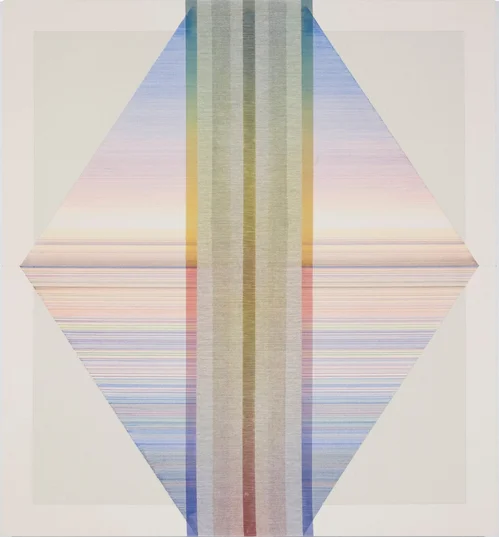
Thousand yards of the sea 24, 2022
Myles Bennett
Brandt Gallery
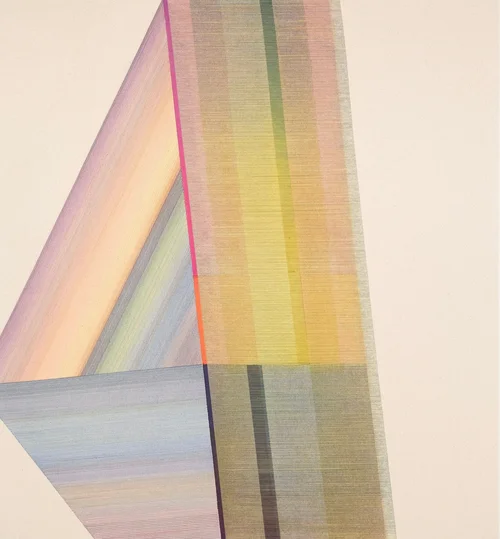
Broken Prism 2, 2024
Myles Bennett
Brandt Gallery
Trained as an architect at the Rhode Island School of Design, Myles Bennett approaches painting through the lens of material and construction. Using an X-Acto knife, the Brooklyn-based artist deconstructs canvas into its component threads, selectively removing portions of its weave and staining the remaining fibers with colored inks. For Bennett, these acts of cutting, removal, and staining become a way of investigating “the formal and expressive nature of the most ubiquitous substrate in modern painting.”
In Manner of Hanon 9 (2024), for instance, washes of coral, sage green, amber, golden yellow, and pale blue sweep across the remaining canvas fibers, forming layered parallelograms as the material folds back onto itself. By exposing the stretcher bars beneath, Bennett rejects the traditional picture plane, making the canvas itself part of the composition.
Represented by JDJ Gallery in New York since 2023, Bennett is currently preparing his second solo exhibition with the gallery, opening October 1st.
Anoka Faruqee and David Driscoll
Faruqee, B. 1972, Ann Arbor, Michigan. Lives and works in Woodbridge, Connecticut.
Driscoll, B. 1964, Steubenville, Ohio. Lives and works in Woodbridge.
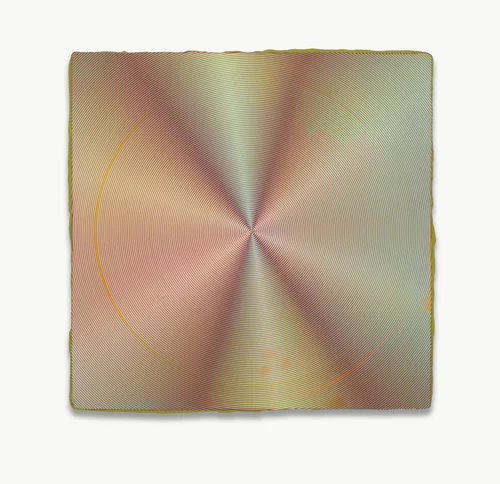
2024P-14, 2024
Anoka Faruqee & David Driscoll
Hosfelt Gallery
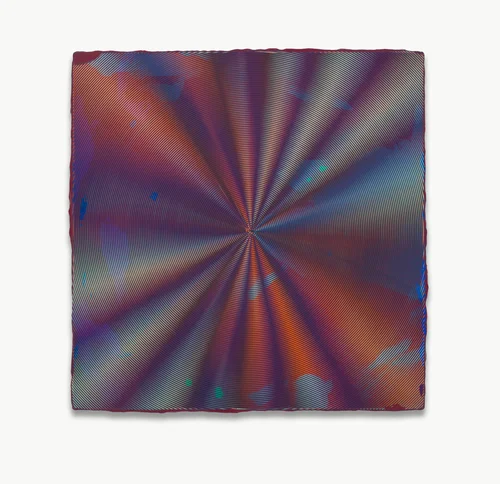
2024P-10, 2024
Anoka Faruqee & David Driscoll
Hosfelt Gallery
When two nearly identical patterns overlap, they can produce a third image neither contains on its own. Anoka Faruqee and David Driscoll have spent more than a decade exploring this phenomenon through their collaborative “Moiré” paintings.
Faruqee, a Bangladeshi American artist, draws inspiration from Persian and Indian miniature painting as well as Islamic geometry. Meanwhile, Driscoll’s study of landscape painting and the natural world informs his approach to pattern and structure. Together, they create densely layered compositions that shift as viewers move through space.
In a 2015 essay on Riley’s artwork Cataract 3 (1967), Faruqee praised the artist’s ability to transform observations of light and pattern into “a wholly new perceptual event.” This influence is visible in her “2024P” series, for example, built from subtly misregistered circular patterns layered beneath textured paint. The resulting interference creates what the artists describe as a form of “engineered instability.” Though highly structured, these paintings retain textural evidence of their making. Paint spills over the edges, and small disruptions emerge across the surface, interrupting otherwise precise geometries.
Represented by Hosfelt Gallery in San Francisco since 2006, the duo has exhibited work widely throughout the United States.
Mano Penalva
B. 1987, Salvador, Brazil. Lives and works in São Paulo.
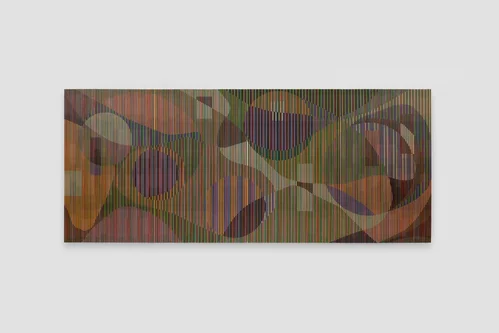
Manglar, 2026
Mano Penalva
Simões de Assis
Drawing on everyday materials and vernacular forms, Mano Penalva creates works that blur the boundaries between sculpture, painting, installation, and architecture. For the Brazilian artist, geometry is inseparable from lived experience. As he told Artsy, “Geometry, for me, is never fully autonomous; it remains connected to labor, hand-making, and everyday life.”
These concerns converge in Manglar (2026), part of Penalva’s ongoing “Ventana” series. Constructed from nylon straps commonly used in market bags and beach chairs, hand-painted wooden slats, enamel paint, and beads, the work layers bands of terra-cotta, ocher, olive green, plum, and cream across a woven framework. Composed of more than 240 individually painted slats, Manglar shifts according to the viewer’s position. Viewed from the side, its rectilinear structure reads as a precise geometric construction; viewed head-on, it gives way to an undulating composition of overlapping forms.
Penalva is currently preparing for his exhibition “Moiré Bereguedê” at the Museu Oscar Niemeyer in Curitiba, Brazil.
Verónica Di Toro
B. 1969, Buenos Aires. Lives and works in Buenos Aires.
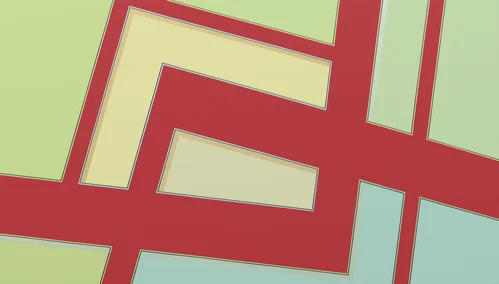
Nº16, 2011
Verónica Di Toro
Gachi Prieto
Repetition lies at the center of Verónica Di Toro’s practice. Working in geometric abstraction for more than two decades, the Argentine painter builds compositions from simple structures that are repeated, rotated, and reconfigured through subtle variations in color.
This approach is evident in works from her “Grid Series.” In Grid Series #3 (2018), overlapping square modules rotate across the surface, introducing an element of chance within a highly ordered structure. By Grid Series #43 (2022), the composition becomes more condensed, with color arranged in a tighter rhythm of repeating units. Together, the works demonstrate how Di Toro uses repetition and variation to generate new possibilities from a single geometric system.
Represented by Gachi Prieto Contemporary Art since 2018, Di Toro works almost exclusively in series, developing multiple iterations of a single structure before introducing new variations.
Natalia Román
B. 1984, Girona, Spain. Lives and works in Begur, Spain.
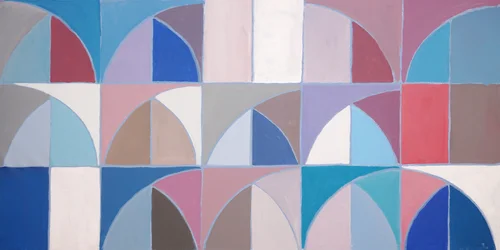
Blue Geometric Drift, 2026
Natalia Roman
Paradiso Images
For Natalia Román, abstraction begins with observation. Looking closely at flowers, ripples, and other recurring forms in nature, she studies the ways patterns grow, expand, and transform over time. For Román, “Nature repeats itself, but always in a subtly different way,” as she said in an interview.
That idea is evident in paintings such as Tulip Echo (2026) and Coral Ripples (2024). Arches, crescents, and petal-like forms in varying hues repeat across gridded compositions, creating patterns that seem to expand and transform across the canvas. The resulting paintings recall the curved forms and heightened color relationships that became increasingly important in Riley’s work from the 1990s onward.
Influenced by mid-century design and Bauhaus ideas matching form and function, Román reduces her visual vocabulary to essential shapes while exploring the expressive potential of color. Represented by Barcelona-based gallery Paradiso Images since 2020, she is currently developing a new body of large-scale paintings that incorporate outlines and contours.
Felipe Pantone
B. 1986, Buenos Aires. Lives and works in Valencia.
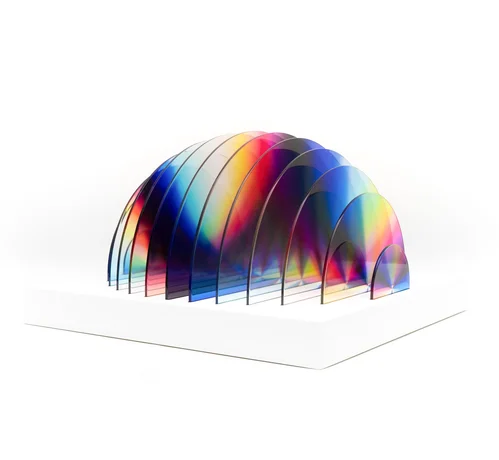
Subtractive Variability Dimensional 10, 2024
Felipe Pantone
Galeria Raquel Arnaud
“Riley makes the eye move,” Felipe Pantone said of the British artist’s work. “That's huge.” With a background in street art, Pantone has built an international practice around a similar question: how can a static image generate a sense of movement? As he shared with Artsy, “I come from graffiti, so for me abstraction was always physical: speed, scale, color, city, repetition. I’m interested in taking that digital speed and turning it into physical objects.”
In OPTICHROMIE STRUCTURAL INSTABILITY 4 (2026), currently on view at “BEYOND THE STREETS” in Paris, pixelated gradients, optical patterns, and fragmented architectural structures collide in a composition that seems to pull the eye in multiple directions at once. Meanwhile, the acrylic sculptures in his “Subtractive Variability Vitreum” series layer transparent bands of fluorescent color that overlap and refract light, recalling the chromatic rhythms of Riley’s later works such as Elapse (1982).
Pantone has exhibited internationally in cities including New York, London, Paris, Brussels, Hong Kong, Tokyo, and Madrid. Based in Valencia, he is currently expanding Casa Axis, a multidisciplinary space that brings together architecture, sound, design, and artistic production.
