


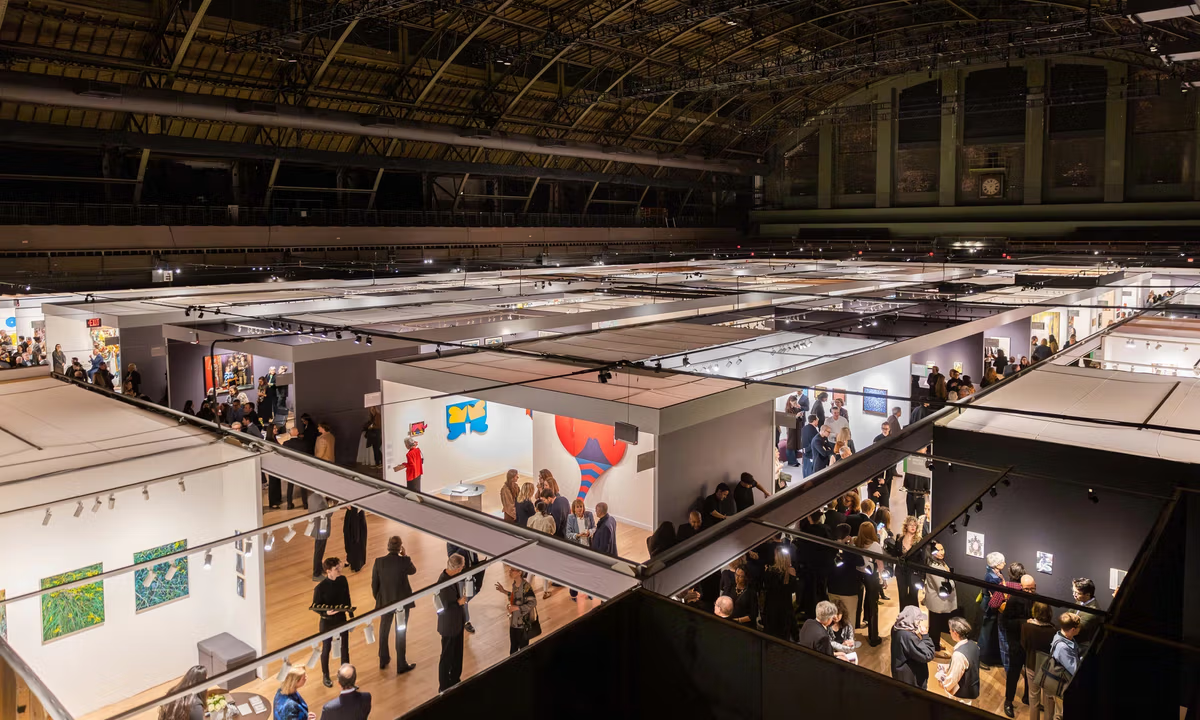
The Art Dealers Association of America (ADAA) has announced the exhibitor list for the first edition of its annual since organisers cancelled the 2025 fair a few months before it was due to open, describing the hiatus as a “strategic pause”. The return also marks the first edition conceived entirely under the ADAA’s current executive director, Kinsey Robb, who was appointed in 2024 shortly before that year’s edition. The fair has been renamed from The Art Show to the ADAA Fair.
“Our pause is something that was important for us and strategic, and something that we wanted to utilise during a moment where the landscape of the art world and the market had shifted a little bit,” Robb tells The Art Newspaper. “We’re building a fair that is approaching the realities that we’re facing today.”
The mood surrounding the art market today is generally more optimistic than when the ADAA called off the 2025 fair a year ago. According to the most recent Art Basel and UBS Global Art Market Report released last March, global art sales rose by 4% in 2025 to an estimated $59.6bn. While the may seem a modest increase, it represents a significant turnaround from the previous two consecutive years of decline. Auction house totals, the most public figure by which to measure the art market, have also made significant rebounds this year.
This year’s fair will return to the Park Avenue Armory, from 13 to 16 November, with 63 exhibitors—around 20% fewer than in 2024, a reduction of about 19 galleries. Robb describes the smaller line-up as “more focused”, saying it allows exhibitors more space, particularly those mounting group presentations.
“Fairs are … thinking a little bit more about their accountability to the exhibitors, and I think galleries in return have been asking harder questions about where they want to invest their time and resources,” Robb says. “From a critical perspective, I think that’s good for the industry because it challenges all of us to create events that deliver value rather than scale for scale’s sake.”
“We’re building a fair galleries want to return to, not simply a fair that has to happen to be larger and larger every single year,” Robb adds. “Every generation of galleries faces different sets of realities, and I think our responsibility as an association is to ensure that the fair evolves alongside the community it serves.”
The exhibitor list reflects the breadth of the ADAA’s membership, from founding members to some of its newest additions. Founding ADAA members Hirschl & Adler and Kraushaar Galleries will participate alongside galleries that exhibited at the fair’s inaugural edition in 1989, including Berggruen Gallery, Gray and Schoelkopf Gallery. This edition will also feature a dozen first-time exhibitors, including Alexander Berggruen, Sargent’s Daughters and Hollis Taggart from New York, Piero Atchugarry Gallery from Miami and Nicodim from Los Angeles.
“Unlike most fairs, our fair doesn’t just begin with an application process; it begins with membership. Every gallery has earned admission to the ADAA through one of the most rigorous peer-reviewed processes in the profession, and the fair exists to showcase that collective expertise of the community,” Robb says. “I don’t really believe that the fair was created originally to compete with other fairs, it was created to express something unique about the art dealers here in the United States.”
The fair’s list of participants reflects a shift towards regional US galleries and newer members of the ADAA. Galleries from Dallas, Baltimore, Memphis, Chicago and St Louis are represented this year, while several of the association’s most recent inductees—including David Lusk Gallery from Nashville, AH Arts from New York and Luis De Jesus Los Angeles—are making their fair debuts. At the same time, the fair features fewer international blue-chip galleries than in previous years. Exhibitors from 2024 that are not returning include Lehmann Maupin, Almine Rech, Timothy Taylor, Michael Werner, Tina Kim and Anton Kern.
Notable presentations from exhibitors that have been revealed thus far include a display of Alex Katz’s works on paper at Peter Blum Gallery; a solo presentation by assemblage artist Betye Saar to mark her centennial at Roberts Projects; paintings by Julie Buffalohead at Jessica Silverman; and a group presentation of artists born in the American South like Red Grooms and Maysey Craddock from David Lusk Gallery.
For 36 years before last year’s hiatus, The Art Show partnered with Henry Street Settlement, the Lower East Side non-profit, raising more than $38m through its annual preview gala. During the fair’s year-long break, Henry Street instead partnered with Independent to raise money during that fair’s preview in May. This year, The fair’s preview gala will benefit the Whitney Museum of American Art.
“Of course we want strong attendance and successful sales for our exhibitors. That’s always something to consider when you’re organising a fair,” Robb says. “But I think success also means galleries feel the fairs justified their investment, that the artist’s work is presented with care, that the Whitney benefits meaningfully from the preview gala and that visitors leave feeling they’ve experienced something distinct.”
