


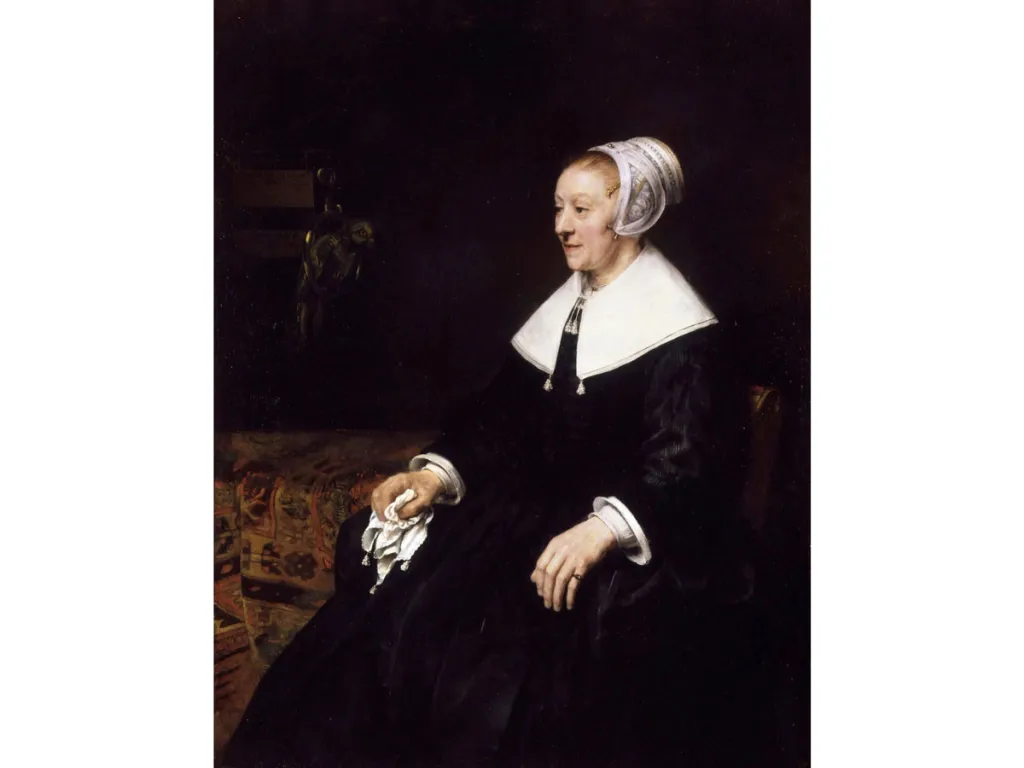
The United Kingdom’s government announced this week that it has put a temporary export ban on a Rembrandt painting valued at £71.7 million ($97.2 million).
The painting in question is Rembrandt van Rijn’s Portrait of Catrina Hooghsaet (1657), which has been on view in the UK since the mid-18th century, according to a release. It was most recently on view at the National Museum of Cardiff from 2016 to 2019.
Rembrandt’s portrait depicts Catrina Hooghsaet, a wealthy member of Amsterdam’s 17th-century Mennonite community who lived separately from her husband. Measuring around 49 inches by 37 inches, the dramatically lit painting shows Hooghsaet, wearing traditional clothing, seated as she stares off into the distance. She holds a white lace in one hand, and behind her is a intricate oriental rug used as tablecloth, as was the style during the period.
“Painted in the final phase of his career, Rembrandt’s portrait of Catrina Hooghsaet ranks amongst his finest achievements. It belongs to a rare group of large-scale three-quarter-length portraits and stands out for its delicacy, refinement, and exceptional finish,” Andrew Hochhauser, who chaired the committee that recommended the export band, said in a statement. “Rembrandt transforms her relatively ordinary features into a striking image of beauty through his sensitivity, honesty and profound psychological insight.”
The goal of the export ban is to prevent the work from “being taken out of the country permanently” and that a UK museum or institution have “the opportunity to save this masterpiece for the nation,” according to a press release. The hefty price tag is “the most expensive object ever to be given national treasure status,” per the release.
“The Portrait of Catrina Hooghsaet has been part of the UK’s cultural life for centuries,” recently appointed arts minister Ruth Mackenzie said in statement. “The scale, beauty and history of this masterpiece make it a priority for cultural partners, funders, philanthropists, and lovers of Rembrandt to help this masterpiece keep its historical place in the UK.”
The export ban, which will last until December 26 (inclusive), was recommended by the Reviewing Committee on the Export of Works of Art and Objects of Cultural Interest, which advises Secretary of State for Culture, Media, and Sport. After that period, the current owners will have 15 business days to accept any offers “at the recommended price of £71,696,324.90 (plus VAT of £754,698.15),” per the release. A second deferral period, lasting nine months, could also be triggered after the parties sign an option agreement.
The committee found that Portrait of Catrina Hooghsaet met the three criteria needed for an export ban, according to the release: “In this case, the painting was recognised for its strong connection with our history and national life, its exceptional aesthetic quality, and its importance to the study of Rembrandt and his work.”
“This is a painting of outstanding aesthetic importance, of outstanding significance to our cultural history,” Hochhauser, the committee chair, added in his statement. “It is also of outstanding significance to the study of the history of portraiture, the oeuvre of Rembrandt and the history of collecting his work in Britain. This enormously important painting should be saved for the nation and kept on public display in this country.”
According to the provenance provided by the UK culture ministry, the painting was first owned by its sitter, who died in 1685; it then passed to her third husband Jan Schildt, who died in 1686. Its fate for the next six decades is unclear until it entered the UK by 1752, when it was likely acquired by John Fane, Lord Le Despencer, 7th Earl of Westmorland, for his Mereworth House in Kent. It passed through the family until an 1831 sale and later sold at Christie’s twice more, in 1846 and 1860.
After that sale, the portrait eventually came into the possession of Colonel the Hon. Edward Douglas-Pennant, 1st Baron Penrhyn of Llandegai and seems to have remained in his family until a 2015 private sale by Sotheby’s. The most recent 2025 sale, which sparked the export ban, was privately brokered by Christie’s.
Artnet News reported market speculation that the painting’s seller is possibly Rosaline Wong, a Hong Kong–based art adviser who has been linked with some of China’s most important collectors, including Joseph Lau and Henry Cheng Kar-shun, the father of Adrian Cheng. In 2023, Wong was reportedly involved in the sale of two paintings by Gustav Klimt. (Christie’s declined to comment on the identities of its buyers or sellers.)
The outlet also reported that Old Master dealer Otto Naumann estimated that the painting could actually be worth about $150 million, or more than twice the value given by the UK government.
The UK government regularly issues temporary export bans on major artworks. The most high-profile of these recently is Joshua Reynold’s Portrait of Omai (Mai), ca. 1776, which received an export ban in 2022; the following year, the National Gallery in London jointly acquired the work for £50 million ($61.9 million) with the Getty Museum in Los Angeles, where it will go on view next month.
