






Chiffon Thomas discovered pretty quickly that New York wasn’t going to work. An artist and sculptor who moved to the city after three years in Los Angeles, Thomas needed a studio with room to weld metal and a parking spot for his van. New York real estate was prohibitively expensive and he went in search of another solution. Detroit and Philadelphia have recently become outposts for artists as New York becomes ever more expensive. The move Thomas eventually made signals that there is another locale joining the mix: New Haven.
Thomas bounced between Bushwick and the Bronx. In Bushwick, the industrial spaces outside Manhattan that once attracted artists are now increasingly rented for all-night raves, co-working spaces, or even converted into a members’ only club. On some nights, Thomas said, events in the building made it difficult to get into the studio at all. The rent was around $4,000 a month. The Bronx was somewhat easier to work in, but it wasn’t much cheaper.
“I was like, this number is just way out of my bracket,” Thomas recalled. Eventually, he was paying around $4,000 for roughly 800 square feet of studio space—just enough to provide ventilation for his welding fumes, and to maneuver long pieces of metal. That came on top of the cost of an apartment in Brooklyn. So in January, Thomas began splitting time between New York and New Haven, where he had attended the Yale School of Art. The cost-of-living difference is almost comic. An 800-square-foot studio in New Haven costs $550 a month. An apartment runs another $1,400 or so.
All in, Thomas said, living and working costs less than $2,000 a month.
“I’ve been able to retain a lot of my income, so I can actually put it back into my studio practice, which is the point,” Thomas said. “You’re really just trying to maintain your small business.” Leaving New York part time, Thomas added, was simply “a business decision.”
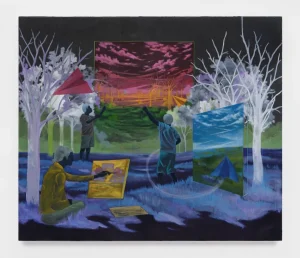
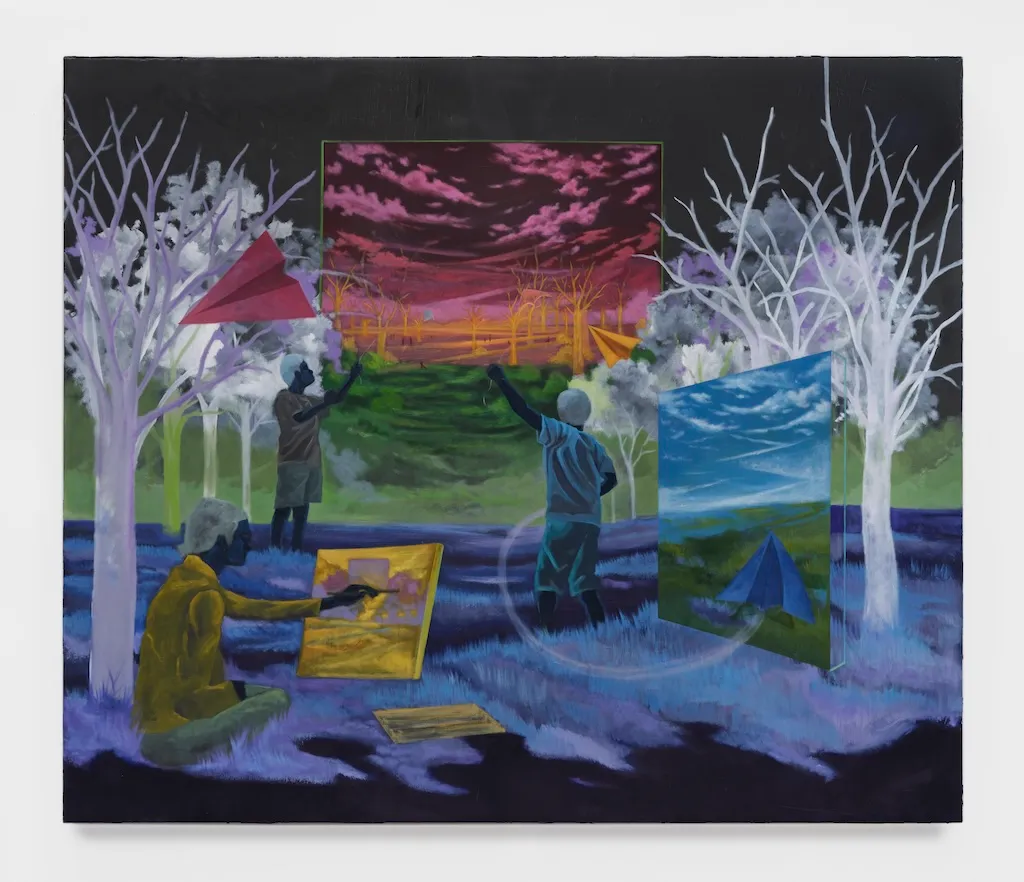
The Aldrich Decennial: I am what is around me (installation view: Em Rooney, Love Streams,
2026, Courtesy of the artist and Derosia, New York), The Aldrich Contemporary Art Museum,
June 7, 2026 to January 10, 2027. Photo: Olympia Shannon.
Olympia Shannon
There has been a lot of hand-wringing lately about whether artists can still afford to live in New York. Late last year, the artist Josh Kline gave this problem a name in a much-talked-about essay titled “New York Real Estate and the Ruin of American Art.” Kline argued that the city’s housing and studio costs weren’t simply driving artists out of New York, but changing the art that could be made there, pressuring artists into making easily marketable work so that they could sell enough to afford small studios. Experimentation and large-scale production, in Kline’s estimation, have disappeared in response. The essay kicked off a frothy argument in the art world, but the diagnosis was hard to ignore. A more interesting question may be what comes next. If artists can no longer afford New York, do they actually need to live there?.
Thomas is one of a growing group of artists in Connecticut, and especially New Haven, who believe they’ve found the remedy for a metastasized New York real estate market.
Some arrived for Yale and never left. Others came for residencies and decided to stick around. A few, like Thomas, trod the well-worth art world path that passes through New York and Los Angeles, before deciding to move back. New York is still a short train ride away, after all.
The New Haven experiment isn’t new. Dominic Chambers, an artist represented by Lehmann Maupin with works in multiple museums including the Hirshhorn Museum and Sculpture Garden, the Los Angeles County Museum of Art, and the Museum of Fine Arts, Boston, moved there in 2017 for Yale’s MFA program. Like plenty of young artists, he assumed New York would come next.
“Every artist that goes to grad school, we all have dreams of going to New York,” Chambers said. “New York’s a fucking dynamic city. There are so many reasons to be there.”
But he’d also heard the horror stories: artists losing studios, rents jumping, people spending huge portions of their income simply holding onto enough room to work. New Haven offered a less glamorous proposition. It was practical.
Chambers’s first studio in New Haven was 1,200 square feet and cost $1,000 a month. His current studio is 1,700 square feet and runs between $1,500 and $1,800, depending on utilities. He lives about 20 minutes away in Meriden, where he owns a house. At first, staying was mostly about money. That isn’t really true anymore.
“A lot of artists have really moved here,” Chambers said. “I haven’t seen a lot of these kinds of people leave.” Connecticut, he said, feels “less isolating” than it did when he arrived.
There are obvious tradeoffs. A curator in Manhattan cannot decide at three in the afternoon to swing by the studio on the way home. Chambers is aware of that. His answer is to make the trip worth taking: “We hope that people take a train ride up to visit us,” he said. “But really we let our work do the talking.”
There is also something to be said for not having the art world outside your front door.


The Aldrich Decennial: I am what is around me (installation view; left: Carl D’Alvia, HotRod,
2025, Courtesy of the artist and HESSE FLATOW, New York; right: Enrique Figueredo, Una
enfermedad que solamente el oro puede curar (A Sickness Only Gold Can Cure), 2026,
Courtesy of the artist), The Aldrich Contemporary Art Museum, June 7, 2026 to January 10,
2027. Photo: Olympia Shannon.
Olympia Shannon
Chambers thinks he might have been more distracted, or simply more anxious, had he moved to Brooklyn after grad school. New York offers extraordinary access to exhibitions and people, but access comes with its own pressure: openings to attend, dinners to go to, people to meet, a studio that must always be ready for someone to drop by.
“You go to New York, you invest so many years and so much capital into that city,” Chambers said. “You just feel like your dreams have not manifested materially yet, despite everything you poured into it.” Failure, or even just the normal slow development of a career, feels different when the rent is $1,000 than when it is $4,500.
And New Haven has affected the work itself. Chambers wanted a yard. He wanted dogs. He hikes. The woods and landscapes around him have gradually found their way into his paintings. New Haven, Chambers said, has given him “time to catch up with yourself in a way that New York doesn’t.”
Of course, it is difficult to talk about artists in New Haven without eventually arriving at Yale. For decades, Yale has brought a steady supply of ambitious young artists into a city of roughly 140,000 people. The traditional assumption was that many of them would leave after graduation, often for New York. What seems to have changed is the number who don’t.
Amy Smith-Stewart, chief curator at the Aldrich Contemporary Art Museum in Ridgefield, noticed that shift while organizing the museum’s inaugural decennial survey of artists living and working in Connecticut.
The show, “I Am What Is Around Me,” takes its title from a line by Connecticut poet Wallace Stevens and is meant to be the first in a series the Aldrich will repeat every 10 years. Smith-Stewart organized it with curator Caitlin Monachino after more than 100 studio visits across Connecticut, eventually choosing 40 artists ranging in age from their thirties to their eighties. Geographic breadth was a focus. So was avoiding the easy version of a Connecticut show, one dominated by recent Yale MFAs or famous artists with country houses up north in the bucolic Litchfield hills. Artists who had already had solo museum shows in the state were nixed, as were people whose connection to Connecticut amounted to spending a few weekends there each year.
The Aldrich Decennial: I am what is around me (installation view), The Aldrich Contemporary Art
Museum, June 7, 2026 to January 10, 2027. Photo: Olympia Shannon.
Olympia Shannon
The idea is partly to correct for Connecticut’s strange place in the cultural imagination. Maine has artists. The East End has artists. Connecticut has hedge funds and nice schools, or so the stereotype goes. In reality, the state has a long artistic history and an unusually dense institutional one, from the Wadsworth Atheneum and the New Britain Museum of American Art to Yale and, more recently, NXTHVN (pronounced Next-Haven). New Haven itself is one of the most racially and ethnically diverse cities in the state, with Latinos, Blacks, and whites each making up about 30% of the population, accoding to 2020 U.S. Census data. Smith-Stewart said the influx has become especially noticeable since the pandemic.
Then there is Erector Square, an old toy factory in New Haven’s Fair Haven neighborhood where A.C. Gilbert once manufactured Erector Sets and American Flyer trains. After the factory closed in 1967, its new owners began carving the sprawling industrial complex into artist studios. Today, eight of its 11 buildings contain more than 175 studios, over 150 of them occupied. It is the sort of slightly battered former industrial space that artists once found all over New York, and that has become increasingly difficult to afford there.
Chambers described a burgeoning community in non-Yale New Haven: Artists stay, meet other artists, invite people into town, and give the next person one more reason not to leave.
“New Haven is a thinking person’s community,” Chambers said. “If people are interested in engaging and participating with ideas in a smaller community at a smaller scale than somewhere like New York, New Haven is a good place to start.”
NXTHVN has helped widen that circle.
Founded in 2018 by artist Titus Kaphar and investor Jason Price, the nonprofit runs a ten-month fellowship that brings artists and curators from around the world to New Haven. Fellows receive studio space, housing, and a stipend, along with mentorship and professional development. The latter was important to Kaphar, who wanted to provide the sort of practical education about sustaining a career that art schools often neglect. In other words, how to be an artist once school is over.

NXTHVN 2024-2025 Cohort 06 Orientation. Photo by John Dennis. Courtesy of NXTHVN.
“There is a different type of community out here,” said Marissa Del Toro, NXTHVN’s director of programs and exhibitions (and a former curatorial fellow there). “Obviously a slower speed, but it’s still moving.” She said that around 15 alumni of the program, some of whom come in from overseas, now live in New Haven.
Kristy Hughes is one of them. Unlike many of the artists who have settled in New Haven, she has no Yale connection. Hughes, who grew up in Texas and had most recently been teaching at the University of Vermont, came to the city through an NXTHVN fellowship. She had been deliberately applying to long-term residencies that could provide the community and access to a larger art world she wanted without requiring her to live in New York. “I can’t afford to move to New York City,” she said. It was a particularly bad fit for an artist making large sculptures.
Two years later, Hughes has stayed in New Haven. She now has two studios there, one for fabrication and another for painting, and says some warehouse space can still be found for around a dollar per square foot. More importantly, the space has allowed her work to grow. After visiting Hughes’s studio, Smith-Stewart asked her to make an outdoor sculpture for the Aldrich show. Hughes had wanted to work at that scale for years; suddenly she had a studio with 16-foot ceilings and enough room to actually do it. Another outdoor commission followed, and she has another coming up. “If I didn’t stay in New Haven, that wouldn’t have been possible,” Hughes said.
Kristy Hughes, What If You Were Absolutely Straightforward (2024)
Hughes still goes into New York and has friends there, but the old choice between access to the art world and enough space to make her work no longer seems quite so stark. She has artists nearby for studio visits, fabricators who can help build the work and New York a train ride away. “I think I should just stay, you know, instead of keep chasing this thing,” Hughes recalled realizing. “Oh, I think we found it.”
The result is not exactly Brooklyn-on-the-Sound, nor does anyone seem particularly interested in making it that. Smith-Stewart sees New Haven as distinct from some of the other Connecticut communities that have attracted artists. Someone moving to Litchfield County may want acreage, solitude, or a barn that can be turned into a studio. New Haven still feels like a city.
It also has Metro-North. The city works as an alternative to New York partly because it doesn’t require artists to abandon New York. “If people are willing to come to my studio and I don’t have to be in New York City and people will still come, then what am I doing?” Smith-Stewart said, describing the calculus she’s heard from artists. Outside the city, she added, they can put more money into materials and make work that would be harder to afford in New York.
SECTION BREAK
There are signs that the art world itself has not entirely adjusted to this new geography.
Thomas still maintains a room in Brooklyn and travels between New York and Connecticut. Part of the reason is practical. Some grants and residencies require artists to be New York residents, creating a paradox in which artists priced out of the city can also find themselves cut off from opportunities designed to support artists.

Chiffon Thomas’s studio in New Haven, Connecticut. Courtesy Chiffon Thomas.
“These are people who formerly resided there and now no longer can,” Thomas said. “Why are these opportunities snatched away from them?”
Thomas also admitted that returning to New Haven did not initially feel like some triumphant discovery of a better way to live. Quite the opposite. “I was incredibly resentful moving back here,” Thomas said. “I felt like I failed at something.” For generations of ambitious artists, New York was not merely a place to live. Getting there was part of the career itself. Leaving could look and feel like retreat.
Thomas is only now beginning to shake that feeling. Familiarity helped. So did returning to a studio building from the Yale years and finding a broader community nearby that were barely visible from the Yale orbit: working-class neighborhoods, Latino communities, taco trucks, people whose daily lives have very little to do with the university. “There’s a real culture here,” Thomas said.


