





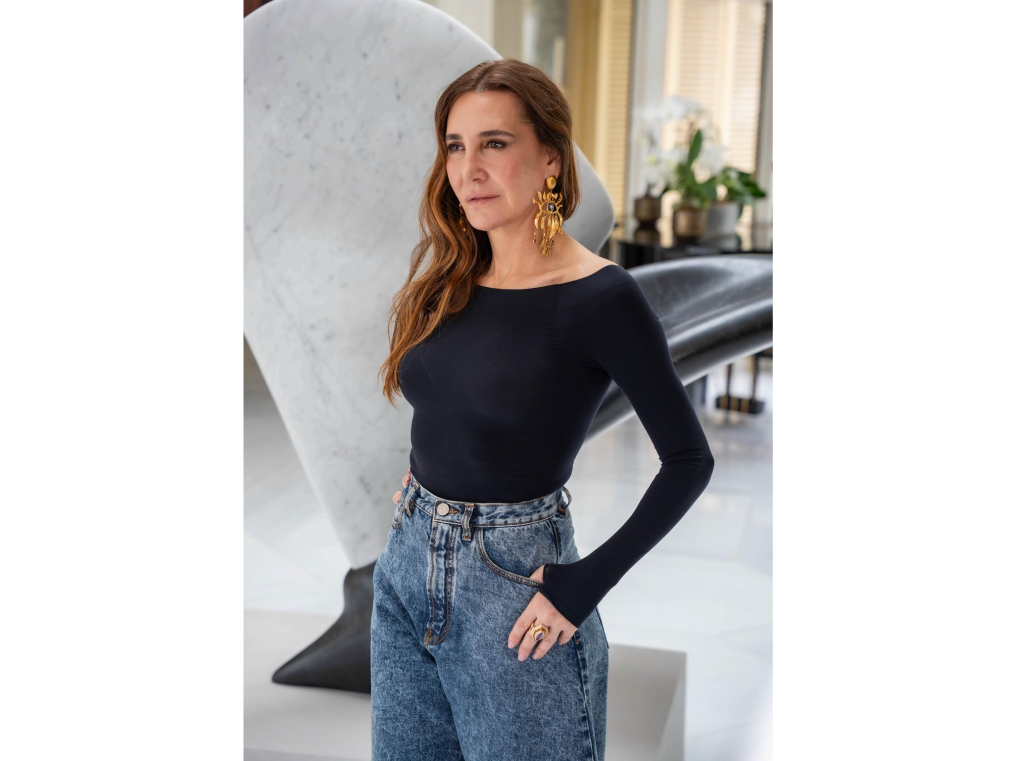
For nearly two decades, Vuslat Doğan Sabancı lived two lives.
By day, she was one of the most powerful figures in Turkish media, serving as chief executive of Hürriyet, the country’s largest newspaper. At night—after work, dinner, and putting her children to bed—she went to her studio and made art. “Sometimes I would work until six in the morning,” Vuslat told ARTnews on a Zoom call from Istanbul.
The strange thing was that almost nobody saw what she made.
Vuslat, who goes solely by her first name professionally, drew, sculpted, worked in clay, and experimented with materials for nearly twenty years without exhibiting any of it. There was no gallery waiting for the work and, for much of that time, apparently no particular ambition on her part to pursue representation. Her first exhibition opened in 2022. Four years later, her art calendar is remarkably busier.
This summer alone, her work has appeared in New York, where she exhibited a room-sized installation, House of Silence, at the Conductor art fair; and in Rhodes, where dozens of her clay sculptures have been installed in a medieval former Greek Orthodox church. May We Meet in the Silence of Our Souls, her first monograph, was published by DISTANZ and the University of Chicago Press. It’s a startlingly fast career ascent for an artist who spent most of her life avoiding one.
An overview of opening night at Conductor, with Vuslat’s collaboration with Tunisian architect Sana Frini, House of Silence, prominent in the center of the room. Photo by Gina Curovic.
Gina Curovic
The tension between public and private runs through much of Vuslat’s work. So does silence. When we spoke with her, she returned repeatedly to the idea of listening: to other people, to materials, to herself. These are not exactly fashionable occupations in contemporary media or contemporary life.
Vuslat knows something about the former. Before leaving the business, she spent years at Hürriyet, where her public life included advocating for freedom of expression, gender equality, and human rights. “I worked in media to create space for different voices,” she said.
But over time, she told me, something changed. Politics became more polarized. Media became increasingly driven by metrics. Everyone seemed to be talking, and fewer people seemed particularly interested in listening. Art offered another possibility.
Vuslat eventually gave the idea a name: emanet, a Turkish word without a neat English equivalent. Vuslat describes it as something entrusted to your care but not really owned. It can be an object, a memory, a story. Children can be an emanet. Nature, too. The responsibility is not merely to preserve what has been entrusted to you, but to care for it before passing it along.


An installation image from Vuslats, May We Meet in the Silence of Our Souls at the 2026 Biennial of Contemporary Keramics. Photo by Ilyada Can.
The effect was simple: you shut up and sat in silence.
But silence, as she describes it, isn’t necessarily peaceful. Quite the opposite. Sit quietly long enough, and the first things that arrive can be judgment, guilt, and criticism. The trick is staying there. “If I stay patient,” she said, “clarity emerges — like clear water.”
Her materials tend to behave similarly. Vuslat works in marble, bronze, clay, felt, and even plants electroplated in silver. She has made monumental drawings using pigments gathered from the earth beneath the places where they are exhibited. For Tower of Babel (2025), she incorporated trees burned in the Los Angeles wildfires.
In Rhodes, where Vuslat is participating in the second Biennale of Contemporary Keramics, the material is simpler still: earth, water, and air. Her installation, May We Meet in the Silence of Our Souls, begins at the threshold of Our Lady of the Castle, a former Greek Orthodox church that later served as an Ottoman mosque. Small organic clay forms lead visitors from the entrance into the building. Vuslat describes them as resembling “the formless shape of breath.”

An installation image from Vuslats, May We Meet in the Silence of Our Souls at the 2026 Biennial of Contemporary Keramics. Photo by Ilyada Can.
ILAYDA CAN
Another question hangs over Vuslat’s sudden arrival in the art world. She didn’t arrive as an unknown. As Vuslat Doğan Sabancı, she belonged to one of Turkey’s most prominent families and had already enjoyed a formidable career in business and philanthropy. Artists spend decades trying to get curators’ and institutions’ attention. Vuslat began showing her work in 2022 and, within a few years, had exhibitions at the Baksı Museum, Istanbul’s Tophane-i Amire, and the Museum of Troy. She knows hers is not the conventional route.
But the chronology complicates the obvious interpretation. Vuslat didn’t leave media, discover art, and rapidly reinvent herself as an artist. The studio came first. For years, it existed alongside her public career, unseen. By the time she finally exhibited at Pi Artworks in London in 2022, she had already spent nearly twenty years figuring out what she wanted the work to do. The critic Andrew Graham-Dixon captured the oddity when he wrote about Vuslat’s debut in her monograph. Vuslat, he wrote, seemed like “a novice and an old hand rolled into one.”


