


The third episode of 2026’s breakout show on Apple TV, Widow’s Bay, ends with the creature of the week—the perpetually sopping Sea Hag—astride her prey: cynical mayor Tom Loftis, played by Matthew Rhys. He’d been warned. Her preferred method of murder is asphyxiation (she sits on your face). Pinned beneath her rotting legs in his recliner chair, Loftis narrowly escapes by yanking its lever, catapulting the hag over his head. The spell breaks; dread collapses with a laugh.
Widow’s Bay was nominated for 19 Emmys last week, an unusual honor for a series committed to bodily indignity. Yet its success feels less like an anomaly than a symptom of the present, in which perpetual crisis has robbed the future of coherence. Cyclically, art history shows how social and political turmoil is metabolized into transgressive imagery: Salvador Dalí’s sun-bleached creature tearing itself apart on the eve of the Spanish Civil War; Francis Bacon’s screaming meat men; Carolee Schneemann unruly unraveling the rules of material, muse, and taboo.
The aesthetic has a name: the grotesque, where horror and humor perform a peculiar emotional alchemy, giving form to otherwise abstract anxieties. Declawed by comedy, fear becomes something the viewer can safely confront, or simply name. What’s down there? Sometimes desire disguised as disgust.
Enter “The New Grotesque,” a stress test for this psychological tool. On view at New York’s Management Gallery, the exhibition treats the grotesque as an aesthetic on the verge of mutation. If every era produces the grotesque it requires, what form does it take when violence, desire, and spectacle no longer linger at the margins, but stream endlessly through our screens? When technology watches us—and when the images it serves grow increasingly untethered from belief—what, exactly, is left to laugh at?
Courtesy of the artist, David Kordansky Gallery, Los Angeles, and Management, New York. Photo by Inna Svyatsky/installshots.art
The show was curated by the gallery’s director, Anton Svyatsky, who has assembled a stellar intergenerational spread from private collections, local galleries, and foreign outfits. A slobbering drunk horse greets visitors at the door; take a left for a sinister eight-piece gouache fairy tale by the Polish artist Aleksandra Waliszewska. Ahead is the show’s apparent anchor, a heady bust from David Altmejd. Decapitated, the fairy of Smoking with Oneself (2021–26) puffs a cigarette from the gaping red maw of her throat. Even in pieces, the self insists: an unbothered face fashioned from trachea and bone takes a drag, too. As Svyatsky put it, compared with documentary imagery, “surrealism absolves the viewer by suspending moral judgment.”
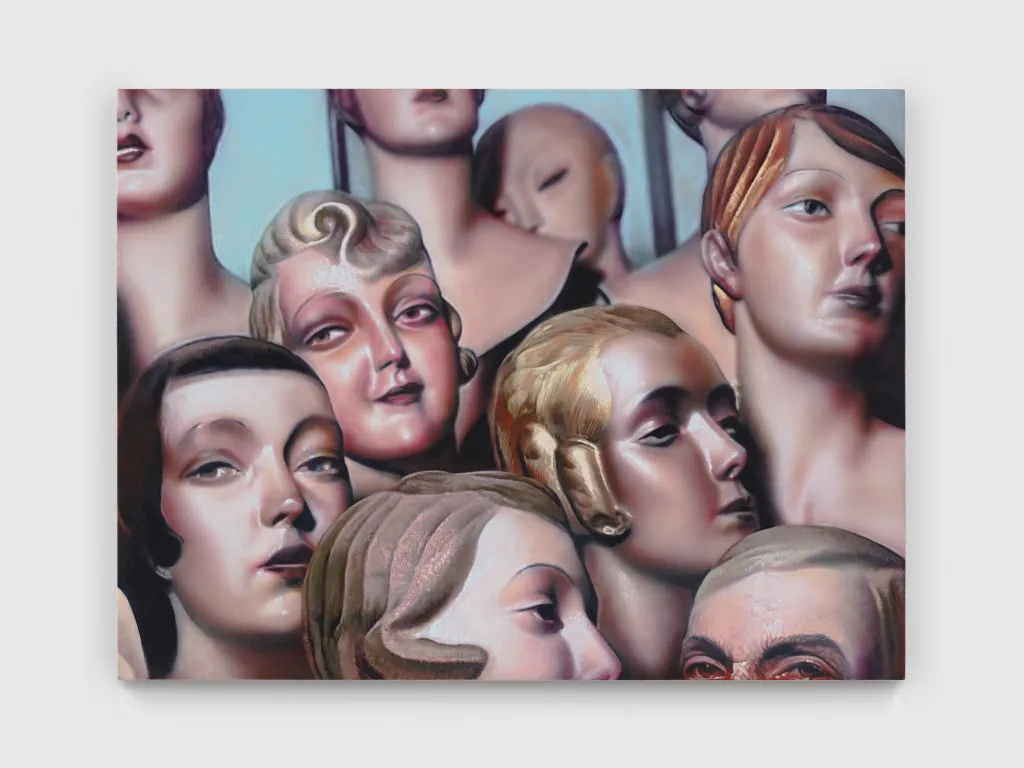
A Canadian sculptor represented by David Kordansky, Altmejd has long explored the porous membrane between body and soul. That preoccupation becomes the exhibition’s throughline, resurfacing in another coup for Management: two untitled pencil drawings by Miriam Cahn, whose 2023 censorship controversy in Paris demonstrated that the grotesque still has the power to unsettle institutions. She’s represented here by a woman dematerializing headfirst, seemingly outlived only by her pendulous breasts, and a sparse landscape where a spectral figure peeks up from the bottom edge. Setting up a funny little fright on the adjacent wall: Tim Brawner’s acrylic postcard from the uncanny valley, featuring chic mannequin heads and there—in the corner—a furious man with twin red suns for eyes cresting the horizon.
The Korean painter Jang Pa, represented by Kukje Gallery, makes her U.S. debut here with Gore Deco—Grinning Viscera #1 (2026), a large, bloody portrait of psychological baggage. Madly sentient guts spill from the sitter’s back in swollen rivulets. The figure is shockingly poised, as if this were just another dull Tuesday. It probably was. Pa’s Gore Deco series imagines the hearts of marginalized people—women, gender-nonconforming, and queer people—as pressure cookers: feverish, crushed against their cages, and rabid to unload on their oppressors. Nothing about it is pretty. What a relief.

An installation view of “The New Grotesque”, including Gore Deco – Grinning Viscera #1 (2026) by Jang Pa and Sibylle Ruppert’s Le Chant de Maldoror (1978).
Courtesy of Management, New York. Photography by Inna Svyatsky/installshots.art
The strongest works in The New Grotesque ingloriously depict the female body as qualified and discarded in equal measure, a battlefield on which wars over propriety are fought. The grotesque offers a reprieve—if not liberation, then at least a means of expression. Beside Pa’s painting hangs the oldest work in the exhibition, and one of its gems: Sibylle Ruppert’s Le Chant de Maldoror (1978), a charcoal drawing of eldritch carnality and half-realized metamorphosis. Tentacles, spider legs, human genitalia—it’s all stock in the same infernal stew. A casual observer might mistake Ruppert for the Swiss artist H. R. Giger, whose biomechanical aesthetic became synonymous with the Alien franchise. They were peers and, by some accounts, mutual admirers.
But while Giger achieved international fame, Ruppert shunned the spotlight and gradually faded into obscurity. Giger also left behind a far slimier legacy, one long criticized for its gratuitous victimization of women. Born in 1946 amid the bombing of Frankfurt, Ruppert instead developed a psychosexual cosmology that rejected neat distinctions between prey and predator. In Ruppert’s hands, monstrosity is not a fall from humanity but an admission of it. Desire makes animals of us. Love leaves us alien to ourselves. The grotesque refuses to look away.
