


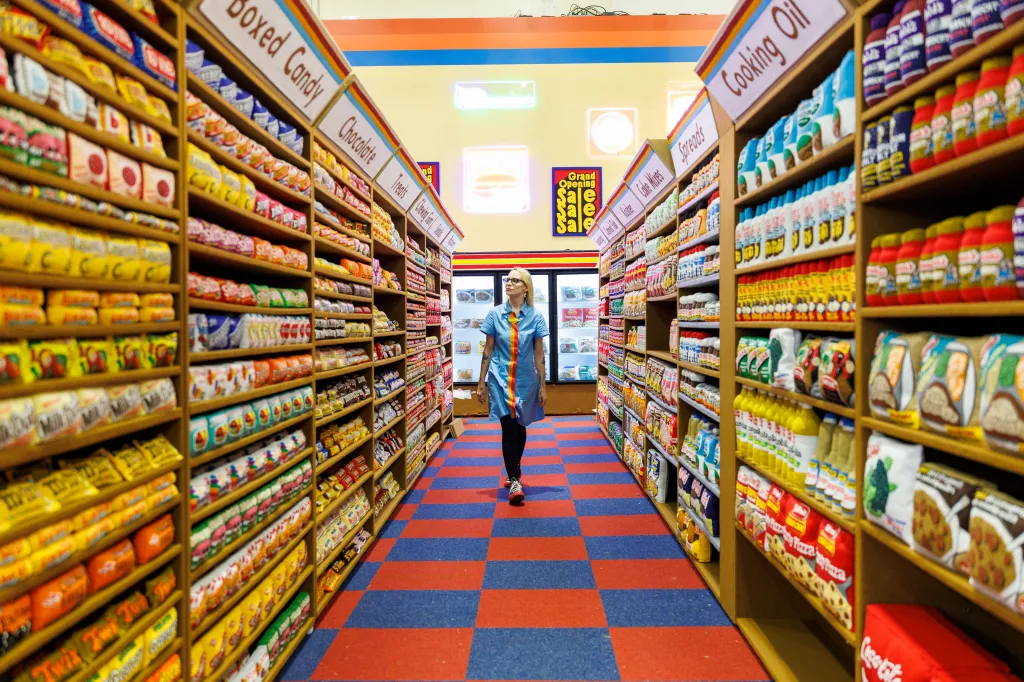
The UK-based artist Lucy Sparrow is known for transforming seemingly ordinary spaces—supermarkets, pharmacies, restaurants, to name a few—into felt wonderlands, celebrated both for their tempting tactility and their technicolor allusions to childhood. What began as a nascent fascination with the material’s ease of use soon grew into a fine art practice, one that asks viewers to see the humdrum artifacts of daily life in a new, playful way.
She first found success in 2014, with the opening of a fully-stocked felt corner store on London’s East End, and has since refashioned entire sex shops, bodegas, farmer’s markets, and candy stores in felt. At these immersive installations, visitors can touch the objects and purchase them directly at the counter, where Sparrow often sits herself. She was commissioned by the BBC to reproduce the Crown Jewels in the plushy fabric in 2016 for the Queen’s 90th birthday, and her work has been featured in over 400 store windows globally, including Hermes flagship store on Rodeo Drive.
On July 18, after previous installations at Art Week Miami, Frieze, and various global pop-ups, Sparrow opened her first U.S. museum exhibition, at the Momentary, an extension of Crystal Bridges, in Bentonville, Arkansas. The exhibition, which will remain on view until next summer, features more than 20,000 replicas of supermarket products, ranging from individual cans of Diet Coke to packaged rotisserie chickens to microwave meals. The supermarket, which also includes a pharmacy, video rental aisles, and a photo kiosk, explores the rise of late 20th century consumerism, when sellers and buyers alike opted for speed over taste.
As Sparrow prepared to open the installation, ARTnews spoke to the artist about her fascination with the everyday and the role of nostalgia in her work.
What were the origins of “The Beginning of Convenience”?
The beginning of convenience started out as a concept for a time when it became more important to have time-saving exercises rather than concentrating on the production of very labor-intensive food, and it’s that period between 1975 and 1995 where things became about speed and convenience. Junk food comes more into our orbit, and I’m interested in all the technicolor things that come along with that.
Your work often deals with community spaces, what about them appeals to you?
It doesn’t matter what your background is, everybody has to come and get shopping. The everyday is this thing that unites us all. Artists across the decades have been drawn to the everyday and try to put it in a perspective that makes the viewer look at it from a different angle. [The Beginning of Convenience] is different because everything is made out of felt and everything is squishy. It’s looking through everything with very childlike eyes.
What drew you to felt?
I’ve been using felt since I was a kid. I always knew I wanted to be an artist, but I grew up with an interest in fashion. So I knew I wanted to do something with sewing. My gran growing up had a clothing shop, so there were lots of old sewing machines in the attic. I used to mess around with the sewing machines with my mum. When I was little, I was always helping make curtains and cushions and all that kind of stuff. For my own projects, she would bring me felt and say, “Have a go with that.” And I thought, “What’s the thing that I really like the most?” and I came up with sweets.
So I tried making my own candy and my own toys. I realized this is the most magical thing ever, and I guess it just ignited something in my head that, as long as I can think of it, and I have the ability to make whatever I want. Felt is so colorful, and the opportunities with it are so great because it’s just so easy to use. Obviously not everyone is using felt on this scale, but I think it shows the extent of what you can achieve with a very simple craft material, and using it in a fine art setting. I think it shows this bridge between craft and art, and what can be achieved with it.
Everybody knows felt. Everybody knows supermarkets. Now they can feel them together.
How do you want viewers to interact with “The Beginning of Convenience?”
This show is a little different to how I usually do my shows because it’s a museum installation and it’s on for a whole year.
The logistics of that obviously means that I can’t be here for a year running a supermarket, which is what I would usually do with my previous shows, where I have a pop up space for no more than a month, and I sell directly from the show. The museum model is different in that everything stays as it is. So for this occasion, there is no touching, which is very different to how I’ve done it before. But it’s got to last a year! It’s got to stay looking really good. And as we know, if you touch things too much, especially felt, it will get damaged. But I didn’t want people to miss out on that chance to touch and everything. So we’ve actually got a petting zoo at the door where you can carry the felt around with you, to join you on your visual journey. And I have a range of pieces that are available in the shop, the same way as I would in all my previous shows.
What are some of your favorite pieces?
The candy is my favorite, purely because of the color, but also because of the amount of work that’s involved in making the nearly 4,000 pieces that go in this section alone. It’s the hardest section to paint because most things need two layers of paint, so whatever I’m doing, I have to do it twice. It’s so fiddly and I have to paint with a syringe. This was the section I started painting first, in January [2026.] It took me two months to paint the whole section. It’s the biggest section as well. There’s also lots of nostalgia wrapped up in them, nostalgic candy bars that people will remember from when they were a lot younger.
The KitKat wouldn’t be my favorite one to eat, but I absolutely love its packaging. This and the Twix bar have sewn on applique letters, whereas the rest of them are sewn. I love it when the letters are sewn on.
What role does nostalgia play in your artistic practice?
Nostalgia has always played such a massive role in my work. I go through my life looking at things through the eyes of a child. Mine isn’t even an inner child; it’s the most outer child you can possibly imagine. I’m not bored by things. I’m still fascinated by the everyday and seeing everything through like this technicolor vision, and I don’t ever want to lose that.
I still have to do sensible things in my adult life. But at the same time, I like to think that I can always see things through the lens of playfulness.
