


Within this collection of essays, Jeremy Harding, author of Small Wars, Small Mercies (1993) and Border Vigils: Keeping Migrants out of the Rich World (2012), explores the way artists and filmmakers have used their work to react to a history of European colonialism in Africa. He also offers nuanced commentary on the writings of the philosopher Albert Camus and those of the ethnographer Michel Leiris, and ponders how Western museums can best address the presence of plundered goods in their permanent collections.
Despite this wide-ranging approach, Harding’s point of view is eminently focused. As he explains in the introduction, these writings “touch closely on a period when African values and aspiration were available to the rest of the world through ambiguous intermediaries”, a group that includes everyone from geopolitical representatives to academics and historians. Some of the essays focus on the oeuvre of specific artists, while others examine institutional responses to the end of colonialism.
Exhuming history
In his description of South African artist William Kentridge’s Night for Day (2003) from the suite 7 Fragments for Georges Méliès, Harding creates a compelling evocation of the film itself. “Stop-motion and reverse-motion produce bizarre effects as Kentridge is shown drawing, erasing, reinscribing—sometimes a line inscribes or reinstates itself—on sheets of paper.” He references Kentridge’s approach to both apartheid and South Africa’s industrialisation in his work, contrasting Kentridge’s methods with those of the Ghanaian-British artist John Akomfrah, and demonstrating very different ways to exhume history.
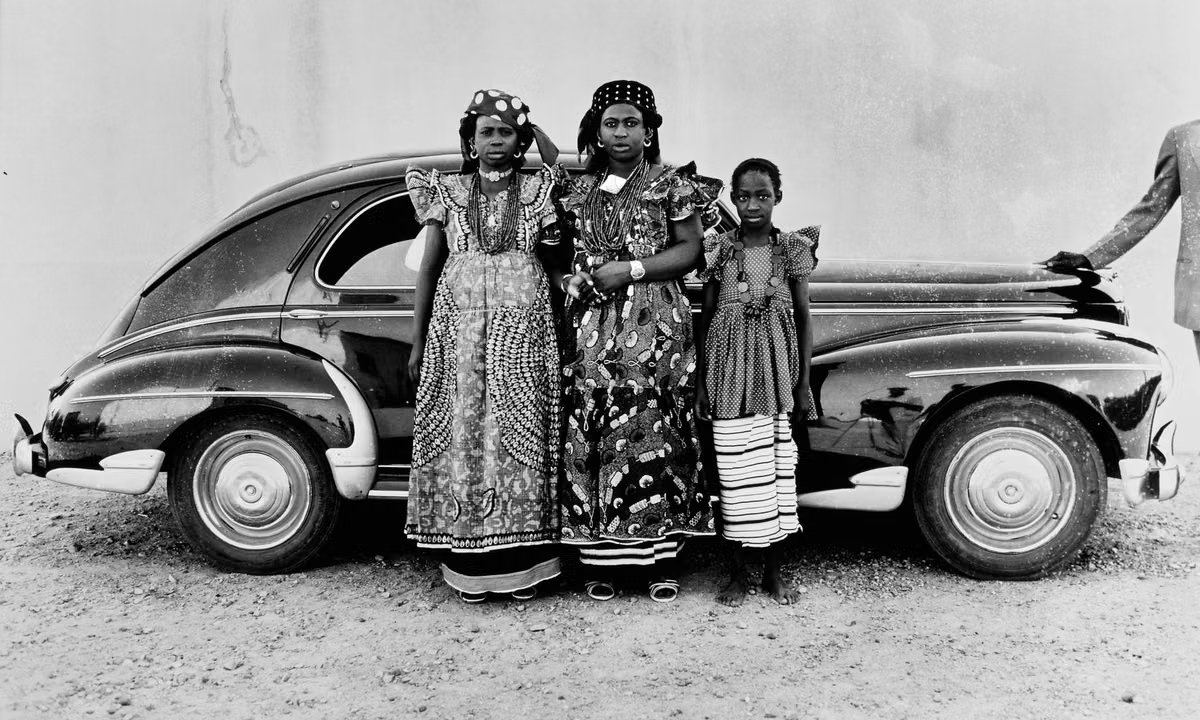
The mention of industrialisation is one of several ways by which Harding introduces the economic effects of colonialism and post-colonial societies. He returns to this question from another angle in his study of the 20th-century Malian photographer Seydou Keïta, who began taking portraits in the 1930s and eventually worked in post-colonial government in the 1960s. Harding observes that a “Keïta portrait was often a collaborative venture: the sitters were his principals and he was their director”, and how Keïta’s use of props, including his own car, a Peugeot 203, reflected larger societal concerns and his subjects’ “desegregated access to metropolitan consumer markets”.
Understandably, Harding opens the volume by discussing the colonial period itself, and how it continues to shape debates and negotiations over plundered goods and attempts by museums to rectify their own history. Of these, Harding’s discussion of the Royal Museum for Central Africa in Tervuren, Belgium, is particularly memorable. Belgium’s colonial policies in the Congo Free State (1885-1908) under King Leopold II imposed, in Harding’s words, a “terrible cost” on the Congolese. The museum itself, Harding writes, began its existence as “a temple of racist kitsch” and has since sought to achieve a more ethical position. That has taken several forms, including an architectural renovation and the addition of work by contemporary Congolese artists to the museum’s collection.
Intriguingly, Harding brings up another dimension to the challenges created by plundered artwork: even well-intentioned institutions seeking to make their collections more accessible can be on the wrong side of state visa policies. Of the Tervuren collection, Harding writes: “Congolese researchers who would like to explore the archives for themselves—and whose interpretations could be at variance with those of their European counterparts—are held back from entry to the EU by strict visa regimes.” Magnify this problem across dozens, if not hundreds, of museums around the world, and you realise just how extensive this problem might be.
Harding is candid about his own opinions. Early in the book, he offers one prescription to the questions of stolen art and its restitution: “Is it cynical to suggest that a museum can never be fully decolonised until those artefacts are returned to their places of origin, leaving rows of empty vitrines with title cards identifying their former contents—and until the comfortable notion of finders keepers is no longer tenable?”
Roads not taken
As Harding explains in the acknowledgements, these essays span a period of more than 20 years, with the earliest appearing in a 2001 issue of the London Review of Books. The author writes that he tried “to avoid disingenuous revisions” in revisiting these texts, pointing out a handful of instances where a postscript was necessary. One such case, an addendum about the rightward political shift of Kamel Daoud, the Algerian author of The Meursault Investigation (2013), is a fascinating study in its own right. A tantalising glimpse of other roads not taken is offered by certain other details, such as the fact that Sarah Maldoror, the late French-Guadeloupean artist and film-maker, made a now-lost documentary about the Cuban-born painter and sculptor Wifredo Lam (1902-82).
That idea of lost potential runs throughout the book, suppressed by colonial policies and repressive violence
That idea of lost potential runs throughout the book, suppressed by colonial policies and repressive violence. The broad remit of Analogue Africa may seem daunting at first, but the wide spectrum of artists and writers covered ultimately makes for a revealing survey of how wildly different thinkers have transformed societal and personal concerns into compelling art. It is both a forceful argument and an unforgettable survey of an artistic reckoning.
• Jeremy Harding, Analogue Africa: Notes on the Anti-Colonial Imagination, Verso, 224pp, £19 (hb), published March 2026
• Tobias Carroll is the author of Political Sign (2020) and the novel In the Sight (2024)
