


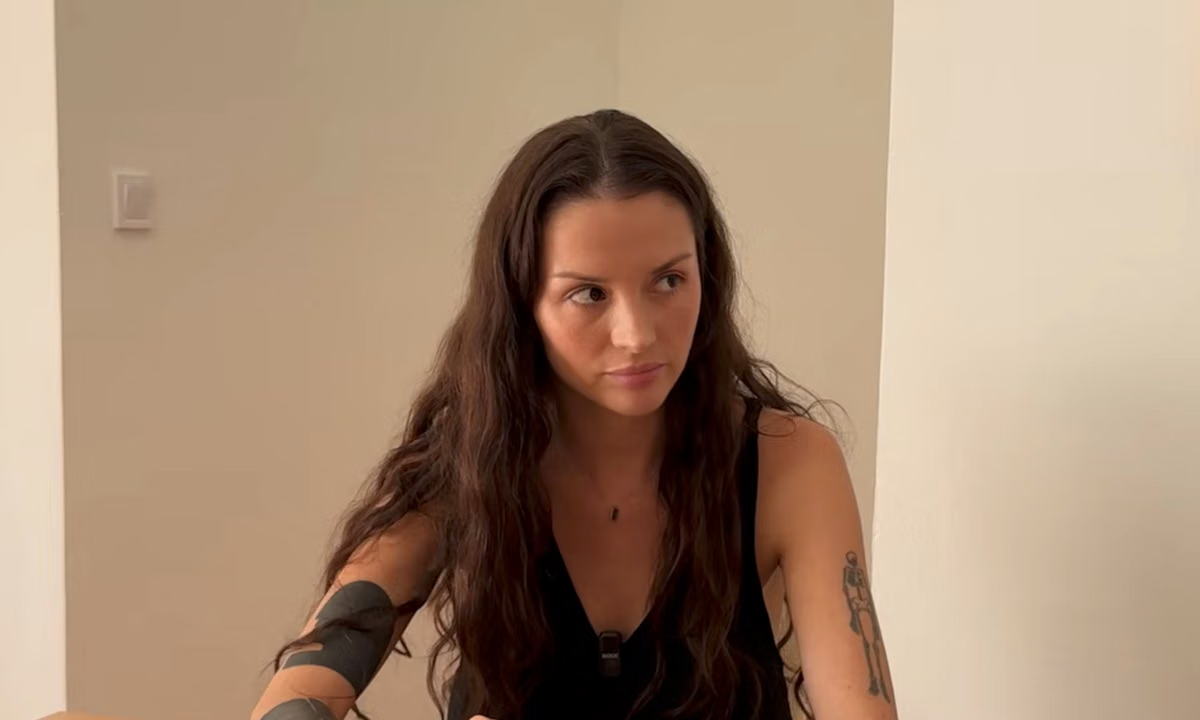
Rita Flores, a former member of the punk collective Pussy Riot whose real name is Margarita Konovalova, claimed in a video interview posted on YouTube on Monday (24 August) that Russia’s FSB security service had pressured her to work for the agency starting in 2023.
The interview, published by Port Media, a site created by Russian journalists forced into exile, illustrates how president Vladimir Putin’s regime has sought to intimidate artists as it continues its full-scale invasion of Ukraine, now in its fifth year. Flores said that agents threatened to kill her family and arrange her forced disappearance while searching her apartment and seizing her telephone and laptop, pressuring her to report on other contemporary artists.
“It was just like in the movies: we sat down at the table, and I wasn’t allowed to move or look away,” she told Port Media. “They started trying to recruit me, resorting to all sorts of threats and mockery, saying truly nasty things, threatening to kill my family, and claiming I’d never be able to prove who killed my mother. They got personal, calling me vile and terrible names, and saying they’d turn me into the ultimate Satan of all Russia.”
Flores says she was threatened with prosecution for social media posts about the Russian massacre of civilians in Bucha, near Kyiv, in the early days of the invasion. She had already been jailed in 2021, when Pussy Riot members faced multiple arrests for speaking out against the Putin regime.
In the wide-ranging interview, conducted by her lawyer, Dmitry Zakhvatov, in an unnamed location, Flores described operations that the FSB started against the street artist Philippenzo (real name Filipp Kozlov) and the performance artist Pavel Krisevich. She claimed she instigated arguments with them to avoid completing her FSB assignments, a tactic she says she used with other artists as well. Philippenzo was forced to flee Russia in 2023, when he was facing up to three years in prison for anti-war graffiti depicting a combination of the words for “Russia” and “rape”. Krisevich fled Russia in late 2025 after serving three and a half years in prison and being re-arrested multiple times.
In a subsequent post on Instagram, Flores thanked Zakhvatov and Leonid Nevzlin, an exiled Russian Israeli businessman who funds anti-Putin activists, for saving her life by spiriting her out of Russia to safety. She wrote that she had attempted suicide several times. She directed others who have been recruited and want to get out to a Telegram channel with instructions from Zakhvatov on how to get help. Zakhvatov, who defended Pussy Riot members, including Flores, in Russia in 2020-21, was sentenced in absentiaby a Russian military court to 21 years in prison for supporting Ukraine’s military. He was declared a “foreign agent” by Russia’s justice ministry in 2025.
In the interview, Flores claimed the FSB had assigned her to lure Pyotr Verzilov, a founding member of Pussy Riot, to Serbia, where Russian agents would kidnap and kill him, offering her up to 3m rubles (around $36,000). She said she contacted Zakhvatov after that to seek a way out. Verzilov has been officially labelled a terrorist in Russia for joining Ukraine’s military.
In response to Flores’s interview, Philippenzo posted a Facebook message accompanied by a 2017 painting that was seized by the FSB during a 2023 search of his home and studio. “It depicts the FSB emblem—a double-headed eagle, a shield and a sword—symbols of all-powerful, covert authority and control,” he wrote. “However, the ribbon bears an ironic slogan that lays bare a paradox: an organisation that has spent decades cultivating the image of an all-powerful entity increasingly demonstrates systemic failure in practice.”
