


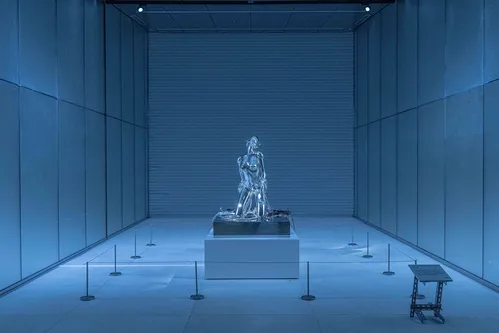
For nearly 50 years, Japanese artist Hajime Sorayama has developed a singular practice with his “Sexy Robots” at the center. These chrome-plated women figures feature impossibly smooth, reflective bodies that mirror viewers and their surroundings. The artist first rendered them in painstaking airbrush, then began sculpting them in mirror-polished aluminum and stainless-steel sculptures. In the mid-2010s, he made them life-sized via digital modeling and collaborations with engineers and production studios.
Sorayama’s robots have reverberated across the worlds of pop culture, luxury fashion, and streetwear. Museums have embraced the artist, who is nevertheless distrustful of taste and global acclaim. “I hate academism,” he told Artsy. “I hate authority.”
This spring, Sorayama is enjoying a sprawling retrospective at Creative Museum Tokyo in Kyobashi. In Toranomon, his work is on view in the massive “Ghost in the Shell” group exhibition at Tokyo Node. Sorayama’s iconoclasm only contributes to his global appeal.
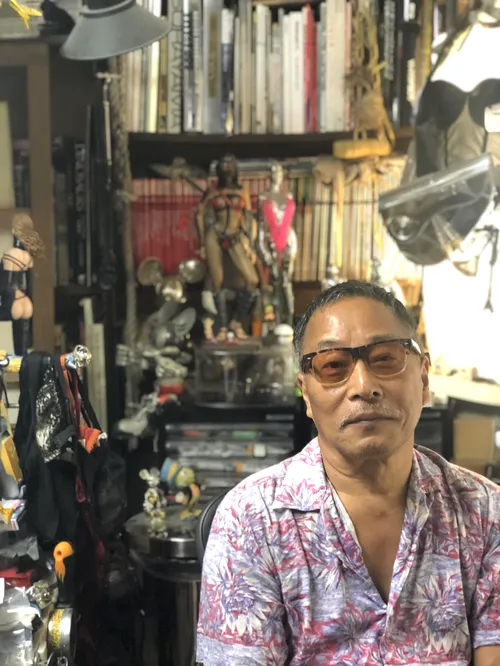
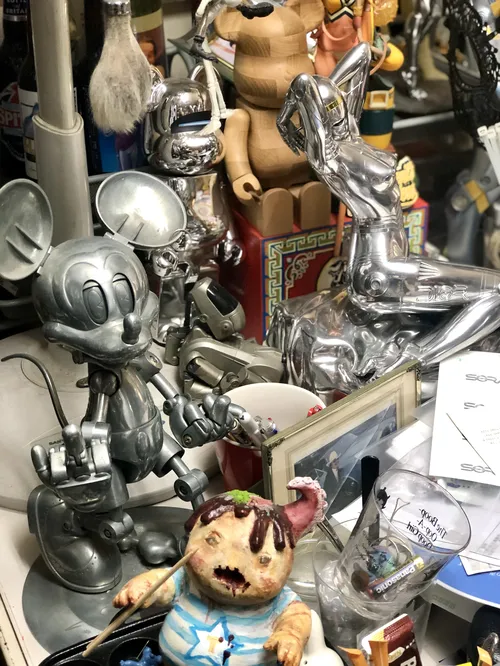
Inside Hajime Sorayama’s Tokyo studio
The Creative Museum retrospective is titled “SORAYAMA: Light, Reflection, Transparency,” nodding to what Sorayama calls the three basic elements of his practice. He’s uninterested in stylistic labels. “I wouldn’t say it is photorealism nor superrealism,” he said. “People tend to put me in that box…That interpretation is not my aesthetic.”
The show is enormous and spectacular, with a huge retail space attached, akin to a luxury brand concession in a department store. Fans can buy Sorayama merch then have lunch in a separate Sorayama bar and café under the same roof. The setup itself feels like another, futuristic universe where you can buy, eat, and look around Sorayama’s brain.
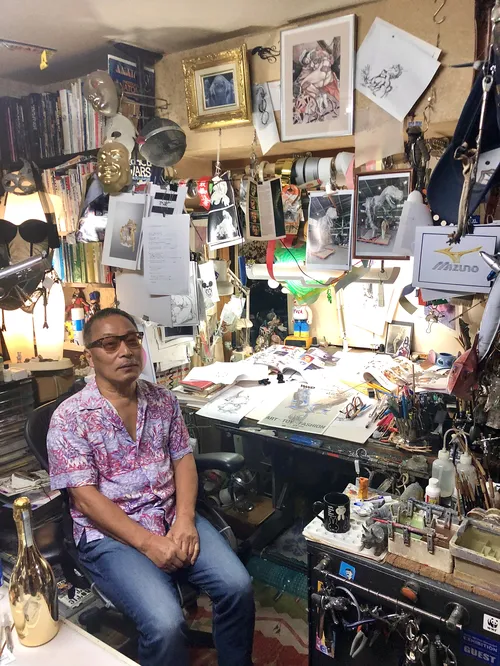
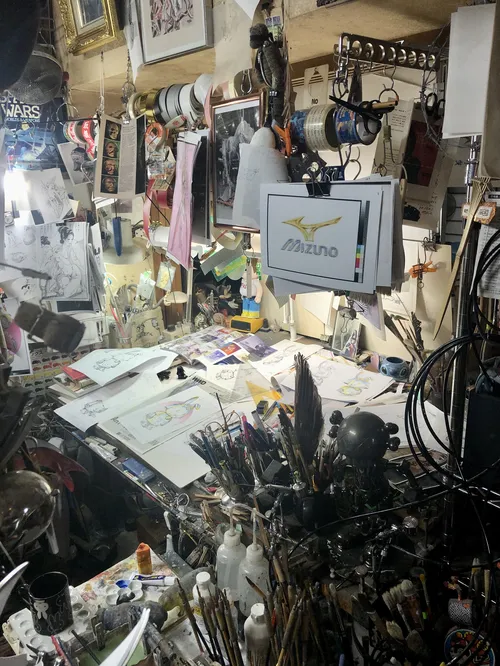
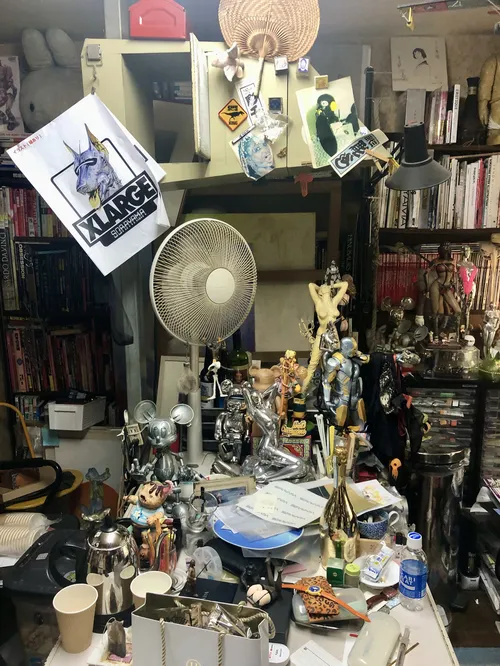
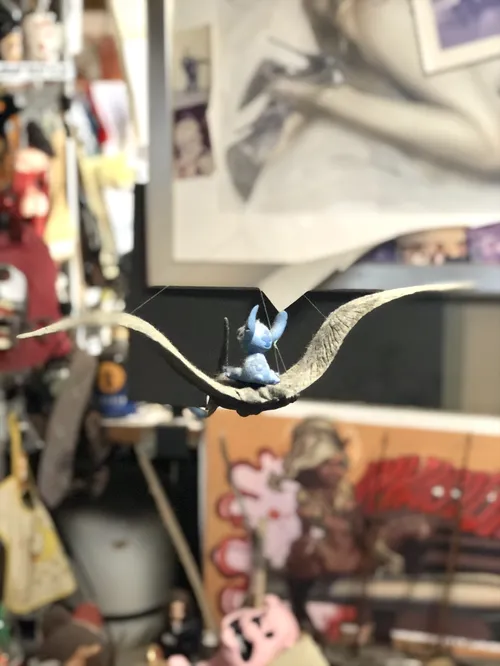
Yet Sorayama’s studio is a much more humble, intimate affair. For more than 40 years, the artist has worked out of a bland apartment building a few minutes’ walk from Tokyo’s Gotanda Station. An enormous, painted femme fatale sprawls across his ceiling. Below, the space teems with chrome figurines, dangling sketches, erotic statuettes, books, clipped reference images, lamps, brushes, bottles, toys, and half-finished ideas. His desk looks less like a workstation than a crowded cockpit of a private mythology.
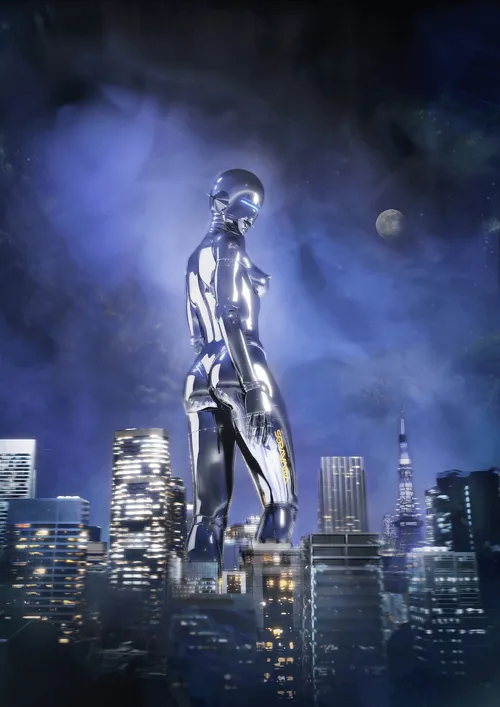
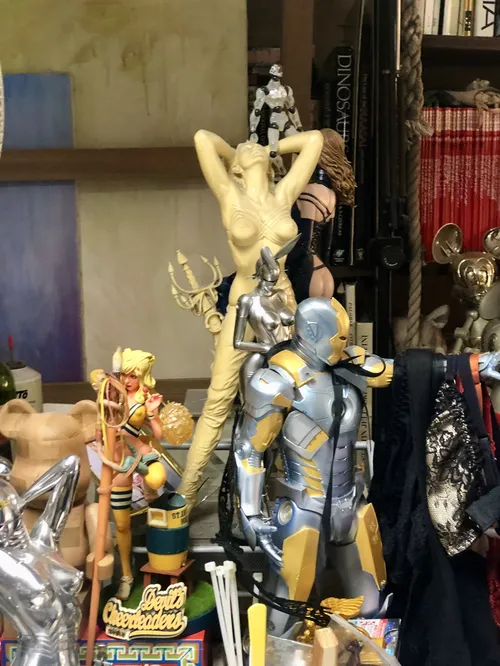
The current retrospective in fact includes a recreation of Sorayama’s desk and office space, folding his process into the presentation of his work. The space’s density and its evidence of fetishistic accumulation are inseparable from the art it produces.
The artist himself is boyish and warm, quick to make a joke. My interpreter explained that the artist is in fact very shy. The artist’s mixture of mischief and reserve helps explain why tenderness and alert, amused sensuality undergird the hard gleam of his surfaces.
Early career
Sorayama was born in Ehime, Japan, in 1947. He trained as an illustrator and began working as a freelancer in 1972. His career as the patron saint of chrome desire began six years later, when he received an advertising commission from Suntory Whisky. The brief was to produce a robot image, since the brand couldn’t secure rights to use the Star Wars character they wanted. The origin story explains Sorayama’s inimitable style, which blends commercial sleekness with erotic futurism. From the beginning, robots appealed as extensions of the body.
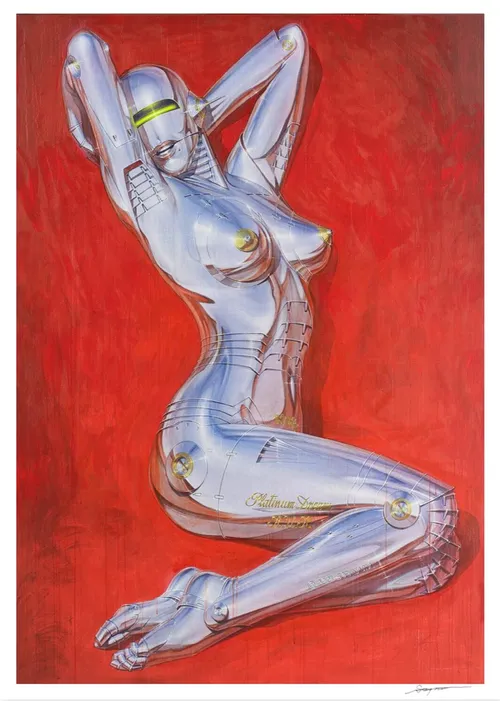
Untitled, 2022
Hajime Sorayama
Curator Cove
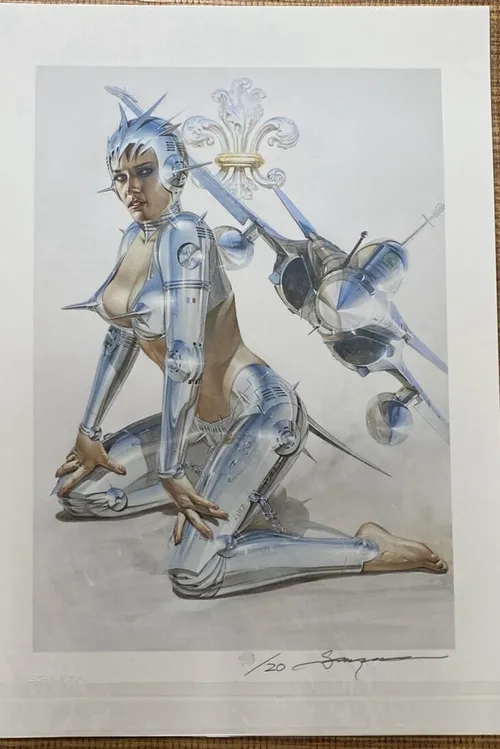
RAFALE, 2017
Hajime Sorayama
Dope! Gallery
A few years later, the artist gave his robotic figures an erotic edge. In 1983, he published Sexy Robot, a book of illustrations that featured hyper-sexualized female androids, rendered with fetishistic precision. The trope took off, inspiring sexy cyborg imagery across pop culture on a global scale. Penthouse caught on and began publishing his drawings into the mid-1990s.
Across Sorayama’s Tokyo retrospective, such figures recur across airbrushed paintings, hallways lined with chrome sculptures, and digital animations. Sorayama’s Suntory ad is included in the show, alongside his 1999 AIBO (autonomous robotic pet dogs) for Sony, one of which is now in MoMA’s collection; cover art for Aerosmith’s 2001 album Just Push Play; fashion collaborations; giant sculptures; and newer immersive installations.
Sorayama never disowned his commercial origins. In fact, he keeps returning to the same proposition: Beauty can be manufactured, and machinery can be sensual.
Mainstream acclaim and fashion collaborations
Sorayama’s work is too perverse for polite design, too commercial for art purists, too technically serious to be dismissed as mere style. This appealing instability has led to both major museum attention and collaborations with sneaker and luxury menswear brands.
Institutions including Tokyo’s Mori Art Museum, Singapore’s ArtScience Museum, and The Jewish Museum in New York all showed his work in the 2010s, placing his work firmly in the realm of contemporary art. In addition to MoMA, his pieces are included in major permanent collections such as the Smithsonian and the U.S. Library of Congress.
In 2019, Sorayama created a monumental mirrored robot for the Dior runway and supplied robotic imagery for the house’s garments. Designers Stella McCartney and Juun.J have also integrated his robotic figures into capsule collections. Streetwear brands BAPE and XLARGE have embraced him, as well as Puma sneakers. Formula One racing star Lewis Hamilton worked with Sorayama to create a sleek helmet and apparel for his +44 brand.
“In a way, I’m more of an entertainer rather than an artist,” Sorayama said. He is less invested in art history than in producing images with emotional voltage. He understands that luxury and fetish share a language: finish, touch, shine, precision, desire.
Sorayama makes no hierarchical distinction between his embrace by museums and by youth culture: “I don’t think there is a mainstream. It doesn’t exist,” he said.
Controversies in Sorayama’s work
Sorayama’s art explicitly objectifies women. The breasts are polished, the waists cinched, the legs often open, the high heels sharpened into weapons. His universe is full of flagrant male fantasy, for which he doesn’t apologize. “Sex is a celebration of life,” he said.
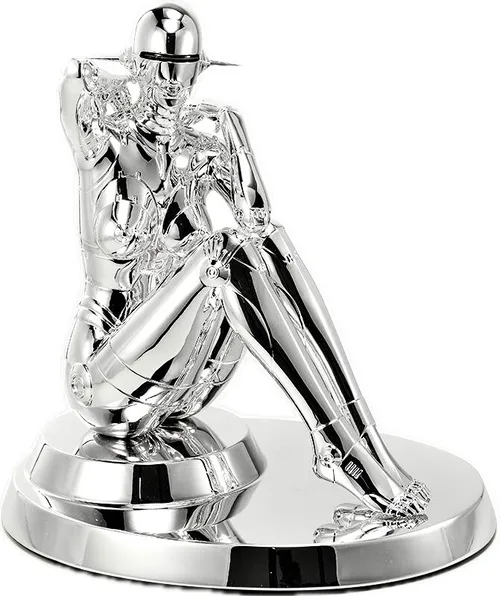
SEXY ROBOT 1/3 scale Aluminium B, 2018
Hajime Sorayama
AYNAC Gallery
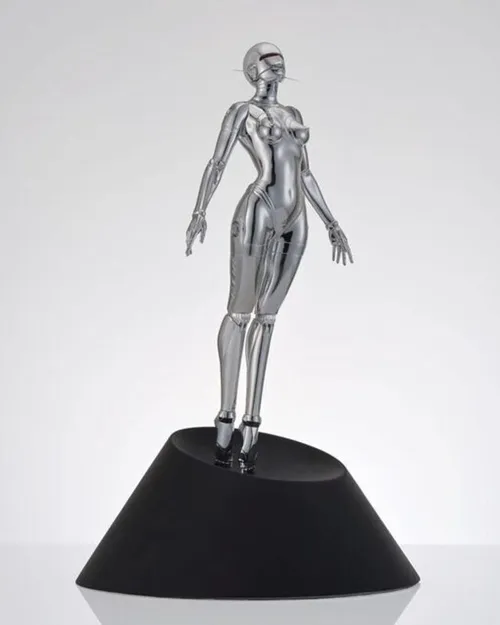
Sexy Robot Floating 1/4 Scale (Silver), 2020
Hajime Sorayama
The BlackWood Gallery
Sorayama’s metallic figures invoke bronze and marble sculpture, pinup art, industrial design, car culture, bondage gear, classical statuary, manga, and religious iconography. This sophisticated mélange and the work’s clear artifice perhaps saves his work from cancellation. About his chrome women, he said: “Up until now, I paint or draw them as goddesses.”
There’s never, in fact, been sustained backlash to Sorayama’s hypersexual, fetishistic, and BDSM-adjacent work. In fact, Sorayama’s most significant dust-up was over authorship. In late 2023, Sorayama publicly suggested that Beyoncé’s Renaissance tour visuals had borrowed from his imagery without permission.
Even that episode speaks to how thoroughly Sorayama’s visual language has entered the culture. Critics and interviewers have certainly described the work as pornographic and “controversial,” but calls of sexism lag behind applause.
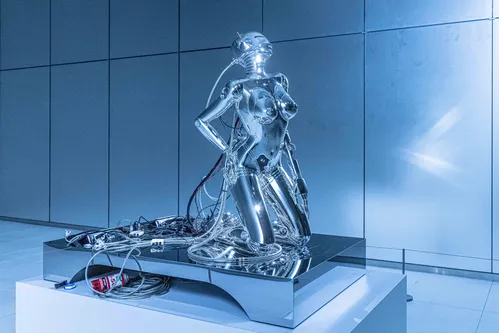
Shift into monumental sculpture and immersive spectacle
Sorayama’s work has gradually grown more ambitious. In 2019, he unveiled an aluminum, 36-foot-long Tyrannosaurus Rex at Bangkok’s Central Embassy, an upscale mall and hotel complex. It was part of an outdoor installation called SORAYAMA Space Park, a collaborative work with Azuma Makoto of the Japanese art duo AMKK.
Two years later, Sorayama further delved into prehistorical forms with his exhibition “Dinosauria” at NANZUKA 2G gallery in Shibuya, Japan. The show featured paintings, sculptures, and of course merch: this time, a collaboration with UNIQLO.
At Tokyo Node, Sorayama presents a gleaming take on Ghost in the Shell, the influential Japanese cyberpunk manga-anime franchise which imagines a world where minds and machines fuse. Its heroine, Motoko Kusanagi, is a powerful cyborg operative whose body has become a defining image of posthuman culture; Sorayama has rendered her in gleaming metal, with metal tubes and threads protruding from her back and skull. These sculptures get an entire hall of their own, facing the landmark Tokyo Tower.
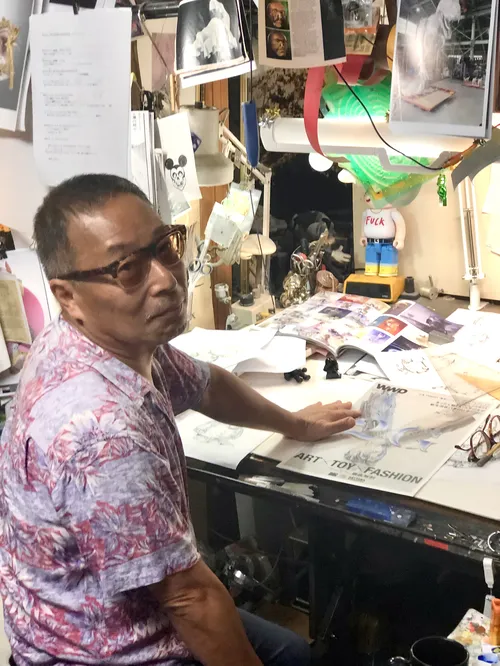
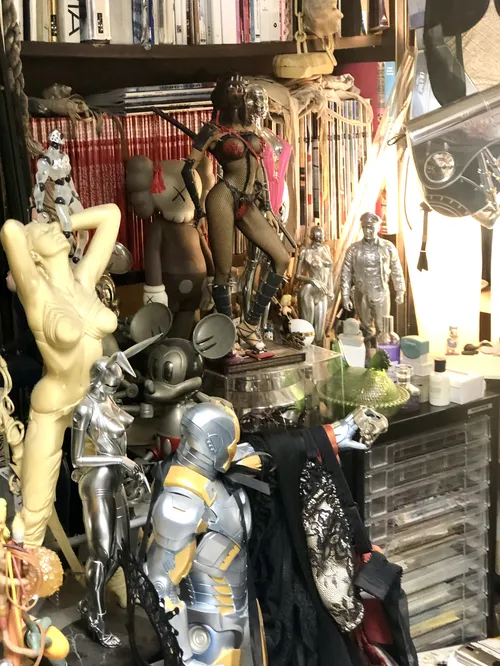
This show and the retrospective confirm that Sorayama has built one of the most recognizable visual languages of the last half-century. He understood that the future would be sold to us as a surface: sexy, frictionless, metallic, and impossible to stop looking at.
Even now, Sorayama’s imagery turns up in locales where glamour slides back into vice. Since 2018, the Shibuya “gentlemen’s club” Madam Woo—a deliberately overripe hybrid of neo-Tokyo fantasy and Las Vegas striptease—has integrated Sorayama’s chrome “Sexy Robot” dancers into its logo and merch.
If Sorayama has secured his spot in the canon, his art still belongs to nightlife, fetish, spectacle, and the charged edge between seduction and bad taste. “I personally love chaos,” he said. “I will never become mainstream. I will always be guerrilla.”
