


It’s hot out and the sun must be at its zenith because you can spot a woman’s shadow against the parched asphalt as she walks down the street. The woman, however, isn’t quite visible. Sometimes you see a bit of her hat, her jacket, or her hands, but mostly she is obscured by a spray of scattered light that warps the world around it. At “The Late,” artist IM Youngzoo’s solo show at Brooklyn’s Space ZeroOne—on view until July 25—the shadow and the attendant wormhole of light leap from one screen to another and another in many different direction. Behind the shadow is Youngzoo with a camera made for filming VR environments, cut to focus on the one point that is usually edited out: the emanating blind spot of the camera.
It is an image that captures the research question at the center of the show: Is an empty hole full of divinity or nothing at all? The 17 works in “The Late” perhaps probe less at that question than the changing nature of the hole itself. From the empty graves (gamyo) of Korean folk ritual to virtual cemeteries, Youngzoo’s work draws a convincing line between the virtuality of spirituality and the belief systems coalescing around different emergent technologies, from NFTs and VR to AI. But it takes some detective work to detangle the web. At the center of the show are two works that share the same name as the exhibition: a seven-channel video work and a 1,254-page book that is the culmination of 10 years of research and experimentation on the meeting of ritual and technological belief.
When first entering the exhibition, the screens surround and overwhelm the viewer at all angles; many are embedded in nooks that one has to crawl into to reach. Though some of these screens display different video works, while others form The Late, all seem to tell pieces of the same story, albeit at different times and from different angles. On one screen, comforting words appeared as “viewing instructions”:
If you are a Gwisin (characters, spirit) remains against the wall
If you are a bird, take your place above
If you are a camera with six eyes, stand wherever you please
If you are a human with two eyes in front, do the best you can
I spent hours in the exhibition, only to feel insecure that I had not put the pieces together. I was convinced that I missed something. It was only after I left the exhibition and began reading the accompanying book that the show began to collapse into stunning resolution. The book, like the exhibition, is overwhelming, resists linear reading, and purposefully drives the observer into a state of disorientation. Yet this disorientation is central to the pathos driving Youngzoo’s work. The artist, her characters, the audience: we are all lost migratory birds who can no longer navigate this big earth through the invisible scientific or spiritual paths that order the world. In the experimental text, Youngzoo tries to find her way back into meaning through art and research.
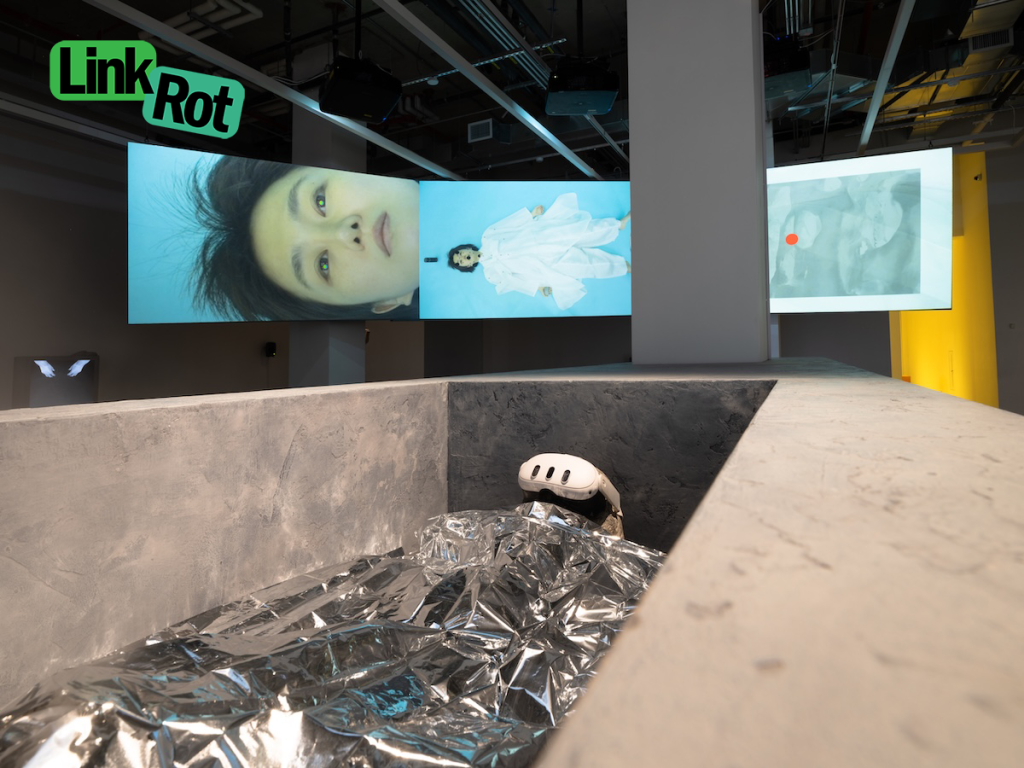
An installation view of IM Youngzoo’s “The Late” at Space ZeroOne. In the foreground is Youngzoo’s 1,254 page book, also called The Late.
Courtesy the artist and Space ZeroOne
If the difference between memoir and autofiction is that in the latter case one is not held to the standard of fact, Youngzoo’s book is what I would call “ficto-research”: research protected from fact by the poetic. The book blurs the line between ethnography, religious study, and media study and contains hundreds and hundreds of fascinating footnotes outlining everything from science-fiction writer Bruce Sterling’s “Dead Media Theory” to the role of birds in Korean shamanism.
Yet, despite a smattering of citations, the work is impossible to fact-check, much less peer-review. This is not to suggest the text presents itself as an academic work. The book is organized in chapters that are not necessarily sequential (there are three to five different ways of reading the book). Fragments of email correspondence appear alongside bits of dialogue, histories of apocalyptic movements in Korea, and poems about the nature of time and the Bardo (the Tibetan Buddhist concept for the transitional period between death and rebirth). A mysterious character, M, ducks behind the pages: are they IM, a friend of hers (often rendered with male pronouns), or a lost bird (mijo)? There are fabulous stories: a tale of a pair of grannies, one Korean and one Japanese, who speak to each other in birdsong; another in which the artist, following the advice of her grandmother, stared at the sun too long and, after a surgery, was left with doubled, unsynced vision between her two eyes (diplopia). In one scene, M takes VR goggles off of a rock-headed dummy, only to see the shape of a bird bloom in the darkness. These stories are woven into the “research” seamlessly: recordings of the grannies’ birdsong are analyzed by ornithologists, the VR goggle scene follows an interview with a man who runs a VR experience parlor. Where the research ends and the fiction begins is impossible to demarcate.
Yet there is something in the book, in the work, in the image of Youngzoo that emerges from all of it, that makes me hesitate to call any of this “fiction.” Reading it, I felt that all of it could have happened because Youngzoo is the type of person who might experience the world in this way.
In illustrating her book not with pictures but with the video works and sculptures in the exhibition, that impossible space between virtuality and materiality comes alive on yet another dimensional line. Youngzoo’s sculptural works ground the overwhelming refraction of the screens, especially Orientation (2025/2026). It is a wooden block with a Go board etched into its top. The Go board represents a “micro-universe” according to the exhibition, due to “its possible positions exceeding the number of atoms in the universe.” Atop the Go board there lies a compass whose dials swing chaotically. If you crouch down, you can see that the compass is not just lying atop the Go board but floating two inches above it, wobbling and spinning on its axis. This piece can be read in the context of an event that rocked Koreans, and the world, in 2016. In March of that year, Korean Go world champion and grandmaster Lee Sedol lost to Google DeepMind’s AlphaGo program in four out of five matches.

An installation view of IM Youngzoo’s “The Late” at Space ZeroOne
Courtesy the artist and Space ZeroOne
How do we orient ourselves as the familiar universe and its coordinates are so severely challenged? Disorientation is a key motif across The Late, not just because of technological advancements, or the diminishment of the spiritual paradigms that used to guide us through life, but because the very act of trying to orient oneself, no matter the technique, is so fraught with danger.
Copies of The Late, the book, can be found in a rectangular hole carved into a giant Go board where audience members can lie and peruse the text at their leisure. As one reads, what were once scattered images become illustrations of scenes from the book: that geological form is not just a giant mineral but Candlestick Rock, “the location of the first sunrise on Korea’s east coast” (137), and an important symbol for Youngzoo’s chapter on the difficulty of syncing timed virtual experiences of the New Year during the Covid lockdown and the nature of time in general. That walk in the snow, and that strange costume: it is a ghillie suit! “The principle of the white ghillie suit is eliminating shadow” (footnote 39, page 195). Youngzoo, or M, took a walk in the suit on the first day of the year to dig an empty grave in the snow. Each work is contained so fully in the text that it is as if each word was generated in tandem with each action. Like the Go board, the book is a micro-universe. Close by, the compass wobbles.
The world-building potential of research is a power not to be underestimated. If you have had parents, friends, loved ones walk down a spiritual, political, conspiratorial path that seems rife with delusion, isn’t one sign of your distance from each other the research that they’ve done, which they find so convincing, but which doesn’t move you, which seems less like information and more like an awful trick? It’s an experience that Youngzoo is familiar with. After art school, she spent her twenties seeking enlightenment and met a yoga teacher she trusted. The teacher planned a trip to India for Youngzoo and her friends, which they paid for. It ended up being a scam and Youngzoo lost her life savings in an act of extreme spiritual betrayal. Over the subsequent years, Youngzoo rebuilt her life and returned to art. Youngzoo’s research is one that moves me, because like good research it obsesses over the shape of a question rather than answering it. And yet that question reverberates in the shape of that giant book. After all the work and careful construction, it’s still all (just?) belief.
