


When I picture cyborgs, I can’t help but picture the ones I know—all of them are disabled. Insulin pumps, cochlear implants, and pacemakers make human-machine hybrids out of people every day. So when I saw that New York’s New Museum was reopening with a cyborg-centric show, “New Humans: Memories of the Future,” I assumed it would account for the disability arts movement blossoming right there in the museum’s backyard.
I winced, then, when I read the artist list and spotted the omission of that cohort—but hey, I’ve been disappointed before. I’m used to being told that disability is “niche,” even though it will come for just about everyone. It’s a human experience as common as love and loss, even if there aren’t really pop songs about it.
Quickly, though, I found that the issue went much deeper than mere omission. The outpouring of Disability Studies scholarship around its central topic, cyborgs, appear unread, the field’s requisite historical correctives omitted. Sadly, tired ableist tropes are here rehashed.
For instance, one video, by Sidsel Meineche Hansen, satirizes the antipsychotic pharmaceutical Seroquel®, but it includes stroboscopic scenes that make it impossible for viewers like me to watch. The work may be about disability, but it is hardly for a disabled audience, since it is blatantly inaccessible. Most promising was a work by Donald Rodney, the trailblazing black British artist who died of sickle cell anemia at age 36. His Autoicon (mid-1990s–2000) is a kind of digital tomb archiving his artworks, interviews, and more. It enlists a Web 1.0 proto-AI to approximate a Rodney chatbot: You can talk to a version of him right there in the museum. Still, it was disappointing that, among the show’s some 200 artists, this is the only work clearly by a disabled person to address disability politically—and it’s about his death.
View of the 2026 exhibition “New Humans: Memories of the Future,” at the New Museum, New York, with work by Donald Rodney on the left.
Photo Dario Lasagni. Courtesy New Museum.
To top it all off, I spotted the term “differently abled” in a wall text: A simple Google search reveals that this is, at minimum, a controversial term. In fact, right there in Merriam-Webster Dictionary is a warning against its usage: “sometimes objected to as an awkward or condescending euphemism”—as if being “disabled” were an unspeakably shameful thing to be.
The curators appear not to have done any Disability Studies homework. While I don’t need or expect the museum to get everything “right,” finding a crumb of curiosity would have been nice. Instead, “New Humans,” when it comes to disability discourse, is hardly new at all.
The show resorts, rather, to 20th-century ideas like the New Man, that optimized and rationalized creature, or to forms of rehabilitation—prosthetics and plastic surgery—that emerged after the mass disabling event that was World War II. In a section on that latter era, called “Prosthetic Gods,” you’d never know of the corporate agenda behind these rehab innovations—to repurpose wounded veterans into a useful workforce—nor its fraught frameworks, often attempting to restore bodies to “normal” rather than equipping them with the tools to adapt. You’d miss that too often, veterans are the only ones with the insurance to cover the latest prosthetics.
Instead, works by Heinrich Hoerle and Berenice Olmedo occupy the “Prosthetic Gods” room: Olmedo’s sculpture Olga (2018) tugs on heartstrings as child-sized orthotics tug on mechanized ceiling-strings. This exoskeleton tries to stand again and again but continually falls, pathetic and petite. Hoerle’s “Krüppel [Cripples]” series, from 1920, excoriates the ways that disability is exacerbated by societal conditions, showing, for instance, a beggar-amputee trapped in a vicious poverty-impairment loop. It’s a promising premise, but ultimately, both works portray a hypothetical disabled person who becomes a flat character, inviting pity and framing disability as a one-note tragedy, as if nothing good could come from it.

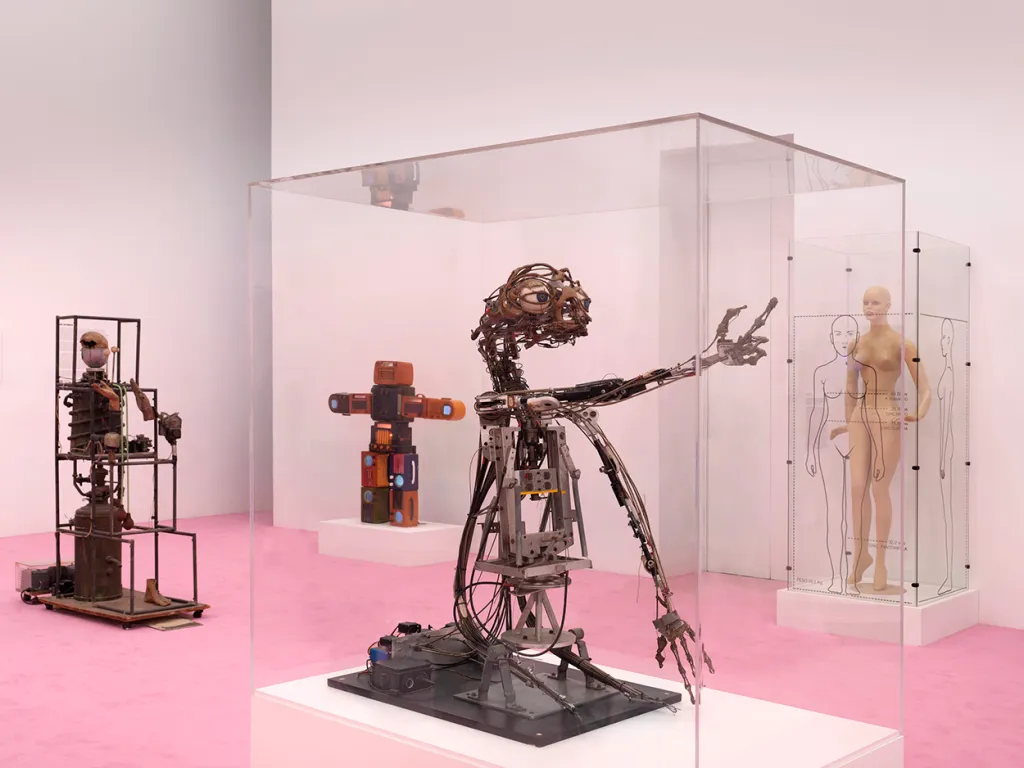
Work by Ryan Gander in the 2026 exhibition “New Humans: Memories of the Future,” at the New Museum, New York.
Photo Dario Lasagni. Courtesy New Museum.
A subtle rejoinder appears in a wall text for Ryan Gander’s mechanical mouse, which explains that his interest in animatronics was born not despite but because of a childhood spent immobile in a hospital bed. The British artist, who uses a wheelchair, has rejected the term “disabled”—an understandable choice given the baggage and stereotypes that clearly persist. But others, particularly in the US, have found the term crucial for forming solidarities across different conditions and mobilizing not against biomedical experiences but against societal exclusion.
“New Humans” has a retro-futuristic bent, drawing largely on 20th-century speculations on the future of the body—never mind that those ideas of optimization clearly failed, nor that impairment is inevitable. Despite the show’s emphasis on corporeality, though, it is not centered on actual bodies—their awkwardness, pus, and guts—but on transcending bodily limitations. Idealized forms favor mythical, metaphoric, and speculative beings. Tishan Hsu’s ambiguous orifices, Jena Sutela’s breast milk from the Milky Way, and Wangechi Mutu’s interpretation of Octavia Butler’s sci-fi story “Bloodchild” are all worthy, lovely projects. “New Humans” is brimming, to be clear, with treasures galore. But cumulatively, given the show’s sidestepping of its subject’s inconvenient truths, one wonders: At what point does its storytelling become speculative, versus simply out of touch?
Work by Tishan Hsu in the 2026 exhibition “New Humans: Memories of the Future,” at the New Museum, New York.
Photo Dario Lasagni. Courtesy New Museum.
It is only buried deep, in a wall text accompanying Franz Tschakert’s work, that you will find any admission that “the notion of ‘technically perfect’ humans” around which the show revolves “proved compatible with Nazi interest in eugenics.” For all the exciting ways the show imagines technology freeing bodies, there isn’t a lot of acknowledging that it’s brutalizing us at the same time. One needs to think only of the thousands of people working in disabling conditions to produce the laptop I am typing on, of the workers who have not been liberated by machines but rather asked to work in more machinelike ways, taking on injuries and illnesses in the process.
When it comes to cyborgs, disability isn’t just part of the story. It’s the heart of it. Our cyborgian future is already here; it’s just not evenly distributed yet.
But don’t take it from me. The art historian Jennifer Gonzalez has argued that the past century of cyborg imagery has “function[ed] as evidence” of the presence of “differences, histories, stories, bodies, [and] places.” The most famous cyborg text—Donna Haraway’s 1985 manifesto—observes, with dated language, that “perhaps paraplegics and other severely handicapped people can (and sometimes do) have the most intense experiences of complex hybridization.” And Sara Hendren reminds how clunky cyborg life can be: Her latest book describes gee-whiz prosthetics gathering dust, amputees taking five years to learn to use a fork with sophisticated-seeming robo-arms, and disabled people devising low-tech alternatives in response.
Too often, as the influential scholar Mara Mills has written, inventions and ideas spring from impairment, that generative force behind so many alternative ways of inhabiting the world. The telephone, for instance, was inadvertently concocted by Alexander Graham Bell as part of his quest to “help,” however patronizingly, his deaf wife and mother “speak.” (Bell, an avowed eugenicist, was intent on eradicating sign language). But when inventions like these, as Mills writes of keyboards and curb cuts and more, find applications in larger markets, their disability histories are too often forgotten. Still, acknowledged or otherwise, disability history is everywhere, and the recent outpouring of art and scholarship spelling it all out makes it a lot less forgivable to forget.
Cyborgian corporeality does not transcend human limitations—it is born of them.
