


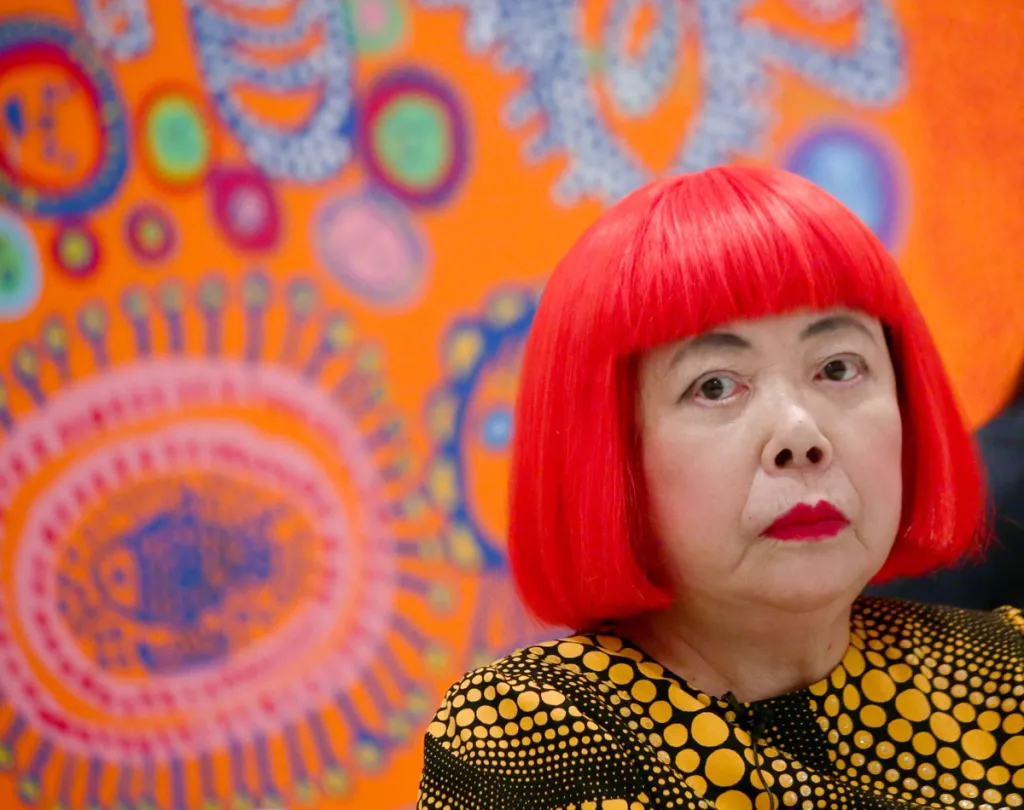
Yayoi Kusama, whose obsessive repetitions of dots and nets became a means of expressing infinity, leaving an indelible mark on contemporary art worldwide, died on August 14 of multiple organ failure at a hospital in Tokyo. She was 97. Her death was reported on Thursday by Kyodo News and later confirmed by her David Zwirner Gallery, her longtime representation.
“It’s been one of the great privileges of my professional life to have been able to represent Yayoi Kusama’s extraordinary art for the last fifteen years,” wrote David Zwirner in a statement. He continued, “The last time Kusama visited New York, a city where she lived for many years, was in 2013. During that visit, she opened the first of many exhibitions in our galleries that had an hour-long lines for the chance to experience her work… At the time of her passing, Kusama was, without a doubt, the most famous living artist in the world. I will miss her terribly.”
Kusama developed a singular visual language that drew on the hallucinations she had experienced since childhood. She emerged as a significant figure in New York’s avant-garde scene in the late 1950s and continued working for more than seven decades, moving freely among painting, sculpture, installation, performance, literature, and fashion. Major surveys of her work have been staged at museums around the world, while her striking likeness eventually transcended into a global brand onto itself, making her the most instantly recognizable artist to emerge from postwar Japan.
From Hallucinations to Art: Matsumoto to America
Born in Matsumoto, Nagano Prefecture, Kusama was the youngest daughter of a family that ran a seed nursery. As a child, she routinely ventured into the fields of violets and other flowers around her home to sketch them. From an early age, she experienced visual hallucinations, which she once described as “flashes of light, auras, or dense fields of dots.” Animals, too, appeared to speak to her, she said. To cope with the intensity of these experiences, Kusama turned to drawing, a practice that would become the foundation of her artistic life. A portrait of her mother, made when Kusama was around 10 years old, for example, is set against a sea of dots. The motif would grow alongside both her compositions and her legend, first engulfing frames, then rooms, and finally entire galleries.
In 1948, at age 19, Kusama enrolled at the Kyoto Municipal School of Arts and Crafts, where she studied nihonga, or traditional Japanese-style painting. She held her first solo exhibition in Matsumoto in 1952 and continued to exhibit in Japan. But she increasingly chafed against what she saw as the constraints of postwar Japanese society, coming to believe that her art required a freer, more expansive environment.
One figure who encouraged her ambitions was Georgia O’Keeffe. Kusama tracked down the American artist’s address and sent her a letter, along with several of her watercolors, asking for advice. O’Keeffe replied. In 1957, at age 28, Kusama left Japan for the United States.
Yayoi Kusama paints body of Kent Feathergill.
NY Daily News via Getty Images
The Birth of the “Infinity Nets” in New York
After spending time in Seattle, Kusama moved to New York and began working in Manhattan. Money was scarce, but her output was prodigious.
It was during these years that she created the “Infinity Nets,” the first major series of her career. The paintings—vast canvases covered edge to edge with minute, repeated loops of paint—drew attention when they were shown at New York’s Brata Gallery in 1959. The exhibition was reviewed by publications including the New York Times and ARTnews.
The obsessive repetition of these marks would become closely associated with Kusama’s concept of “self-obliteration”—the dissolution of the boundaries between the self and the surrounding world, as she described it.
Writing in ARTnews, Donald Judd, then an emerging artist and critic, praised Kusama’s work and purchased one of her paintings. Other artists, including Frank Stella, also took notice. Working as a Japanese woman within the largely white, male New York avant-garde, Kusama gradually established herself as a distinctive presence in the city’s rapidly changing art scene.
Happenings, Narcissus Garden, and the Avant-Garde
In 1965, Kusama debuted Infinity Mirror Room—Phalli’s Field, a mirrored environment filled with soft, phallic forms covered in red polka dots. The mirrors multiplied the objects—and the viewer—seemingly without end. The Infinity Mirror Rooms would ultimately become among the most celebrated works of her career.
Against the backdrop of the antiwar movement and the counterculture of 1960s America, Kusama also staged a series of performances, or “happenings,” often involving nude participants whose bodies she covered in polka dots.
In 1966, during the 33rd Venice Biennale, Kusama staged Narcissus Garden without an official invitation, installing 1,500 reflective silver spheres on a lawn outside the exhibition grounds. Beneath a sign reading “YOUR NARCISSISM FOR SALE,” she attempted to sell the spheres for $2 apiece until Biennale officials intervened.
The gesture provocatively blurred the distinction between artwork and commodity while taking aim at the institutional and commercial structures of the art world. Kusama later reflected on her conception of the avant-garde in her 2013 memoir, Polka Dot Autobiography: “To look back at one’s place in society and create a new history—that, I believe, is what it means to be avant-garde.”
Her guerrilla-style interventions expanded to include nude demonstrations, “Love Happenings,” and polka-dot body painting. Against the backdrop of the Vietnam War and the broader counterculture, her work became increasingly intertwined with political and social concerns.
Kusama also ventured into musicals, filmmaking, and fashion, continually expanding the boundaries of her practice and establishing herself as one of the era’s most singular avant-garde figures.

Infinity Mirrored Room-All the Eternal Love I Have for the Pumpkins at the Hirshhorn in 2017.
The Washington Post via Getty Im
Return to Japan and International Rediscovery
In 1973, after roughly 16 years in the United States, Kusama returned to Japan. There, however, the sensational aspects of her New York activities initially drew more attention than their art-historical significance, and the critical standing she enjoys today was far from immediate.
During this period, Kusama increasingly turned to writing in Japanese. Fiction and poetry offered another means of exploring the self, distinct from her visual practice. Beginning with her debut novel, Manhattan Suicide Addict, she went on to publish novels, short-story collections, and poetry while continuing to make art.
During the 1980s, Kusama exhibited regularly at venues including Fuji Television Gallery. The pumpkin, perhaps the most recognizable motifs in her oeuvre today, became increasingly prominent in her work during this period. A major catalyst for Kusama’s international reassessment came in 1989, when the Center for International Contemporary Arts in New York organized a retrospective of her work. The exhibition renewed attention to her New York years and the pioneering role she had played in postwar art.
Then, in 1993, came a decisive turning point. Kusama was selected to represent Japan at the 45th Venice Biennale, with art critic Akira Tatehata serving as commissioner of the Japanese Pavilion. Twenty-seven years after her unauthorized presentation of Narcissus Garden in Venice, she returned as Japan’s official representative.
Tatehata’s presentation foregrounded Kusama’s pioneering position in a New York art world transitioning from Abstract Expressionism to Minimalism and Pop, while also introducing her more recent work. The Japanese Pavilion became a crucial moment in cementing her reputation, both in Japan and internationally.
In 1998, “Love Forever: Yayoi Kusama, 1958–1968” opened at the Los Angeles County Museum of Art before traveling to the Museum of Modern Art in New York, the Walker Art Center in Minneapolis, and the Museum of Contemporary Art Tokyo. The exhibition prompted a major reassessment of the radical work Kusama had produced during her New York years.
At 70, Kusama’s Career Takes Off Again
Rather than slowing down as she entered her 70s, Kusama continued to expand her practice throughout the 2000s.
Beginning in 2004, she produced the monochrome drawing series “Love Forever.” In 2009, she embarked on “My Eternal Soul,” an expansive series of large-scale acrylic paintings filled with blazing color and motifs resembling faces, eyes, and organic forms. By the time the series concluded in 2021, Kusama had produced roughly 900 works over 12 years.
Her output continued unabated. In 2021, she began a new painting series, “Every Day I Pray for Love,” returning to themes that had occupied her throughout her life: infinity, love, life, and death.
Major museum exhibitions followed around the world. Tate Modern in London mounted a major retrospective in 2012. In 2017, “Yayoi Kusama: Infinity Mirrors” opened at the Hirshhorn Museum and Sculpture Garden in Washington, D.C., before traveling across North America. Her “Infinity Mirror Rooms,” which placed visitors inside Kusama’s endlessly reflected environments, generated extraordinary demand, with lines stretching around the block.
In 2022, M+ in Hong Kong staged “Yayoi Kusama: 1945 to Now,” a sweeping retrospective featuring roughly 200 works spanning nearly eight decades. Even into her 90s, Kusama remained the subject of major exhibitions around the world.
Her imagery also proliferated far beyond museum walls. In 2012, Kusama embarked on her first major collaboration with Louis Vuitton. The partnership was revived on an even larger scale in 2023, when monumental polka dots and animatronic figures modeled after Kusama transformed the fashion house’s stores in New York, Paris, Tokyo, and other cities, becoming a global social-media phenomenon.
Yayoi Kusama attends the exhibition “I Who Have Arrived In Heaven” at David Zwirner in New York in 2013.
Getty Images
In Japan, her yellow Pumpkin on the island of Naoshima became one of the country’s most recognizable works of public art. Large-scale works by Kusama are permanently installed at institutions and sites across the country, including the Matsumoto City Museum of Art in her hometown. In 2017, the Yayoi Kusama Museum opened in Tokyo’s Shinjuku district, establishing a permanent institution dedicated to preserving and presenting her work.
Kusama received the Praemium Imperiale in 2006, was named a Person of Cultural Merit by the Japanese government in 2009, and received the Order of Culture—one of Japan’s highest honors—in 2016.
“Even After My Death”
Kusama continued working into the final years of her life, driven by an unwavering determination to leave her mark on art history.
In Polka Dot Autobiography, Kusama wrote of what she hoped would happen to her art after she was gone: “I hope that the polka dots will continue to proliferate and carry my message to people everywhere. And even after my death, I would be happier than anything if the traces I have left could extend far and deep, continuing without end to reach generations to come. From today to tomorrow, and from tomorrow to the day after, I want to keep working, step by step, to move people through my art.”
